 Flash News
NAMES/ 25-year-old man kills neighbor in Rrogozhina
"Albania is not for sale", the walls of the Prime Minister's Office are 'dressed' with the protesters' messages
Video/ Marjana Koçeku leaves the SP and joins the protest against Rama
"We are the ones who sacrificed for the families... that you forgot", the strong message of the diaspora from the protest
Albanian diaspora joins the march, the largest protest against Rama is expected today
It wasn't the algorithm that caused the anger, but the anger that outpaced the algorithm.

Politiko
2026-06-20 21:25:39

If the vast world of social media could be described in a few words, it would be more or less this: Facebook and Instagram-type media, which are used more by young and middle-aged Albanians, try to keep people on the go as long as possible, by giving them the information that Facebook assumes they are looking for, assumptions based on information collected from user behavior. This business model has led Facebook to acquire content offered for free by users, mainly through personal accounts, and sell the public's attention attracted by this information to advertisers who advertise mainly from pages.
Facebook and Instagram appear to use a fluctuating combination of their interest in content that users give away for free, and their interest in selling ads, to determine the visibility of each post.
Posts that other users are interested in are shown to more people. Posts that are not, the poster will have to pay for advertising in order for the message to be distributed. Advertising, in turn, works like a stock exchange. If there is a lot of demand for advertising, as happens in election campaigns in Albania, the price increases. Consequently, when you are a small business that wants to advertise something during an election in Albania, you may notice how the cost of reaching some potential buyers doubles or triples because the flood of campaign money practically drives you out of the market.
Various groups, including governments, use coordinated behavior to trick the algorithm into thinking that a particular post is of high interest. As at least one US investigation has noted, Facebook has no major concerns about this coordinated behavior, even though it officially considers it illegal. The reason is that the behavior, coordinated or otherwise, serves Facebook to keep more users online for longer.
Those with a lot of resources at their disposal, such as, for example, Prime Minister Edi Rama, try to dominate, and in many cases succeed in dominating, social media through a phenomenon that experts know as saturation. While a critic of the government can make one post, the government has entire armies of propagandists who are able to produce an enormous volume of materials, which, having higher graphic quality, and using enormous financial resources, manage to dominate social media while leaving critical voices isolated in narrow courtyards.
The methods that Facebook and other social networks use to keep users, individuals and advertisers, addicted to themselves have been described by experts as methods borrowed from the gambling industry and have raised concerns that they have created addiction in people. In the gambling industry, the unit of measurement of success is not how much money the gambler has spent in the casino, but how many hours he has spent playing. The time spent in the game is the indicator of success. The money earned is a consequence of this and not the primary objective. The same happens with Facebook, whose interest is to keep people on the platform as long as possible.
Algorithms have created “islands” or “inner courtyards” in which certain groups of users interact with each other, while the algorithm removes any information that the group has not expressed interest in. This is how Facebook has operated for years, creating “echo chambers” or isolated groups of people who circle around each other without looking further.
But on May 31, this system seemed to break down. The avalanche of citizen reactions to the ugly incident of the rape and kidnapping of a citizen by private security guards in Zvërnec was the origin of all this. If you remember, the incident in Zvërnec took place on May 30, a Saturday, and by Sunday, when some citizens in Tirana called for a protest attended by thousands of people, the Facebook algorithm was shaken, not because there was any conspiracy, not because there was any “hybrid war,” but because, unfortunately for the government, citizens were so angry that the reaction on social networks broke the walls of traditional courtyards, overcame islands of isolation or echo chambers, and spilled onto the “Martyrs of the Nation” boulevard.
While traditional media fell silent, citizens noticed the face of the oligarchy: control of the traditional media sphere through ignoring real news and bombardment with spectacle shows and saturation of social media by the government.
Citizen anger was of course not artificially created by the algorithm or any false information. Citizen anger simply reached its breaking point with the incident in Zvërnec. It was anger that broke the algorithm, not the algorithm that caused the anger./ BIRN
Latest news

Ruthless Netherlands destroy Sweden 5-1
2026-06-20 21:41:14

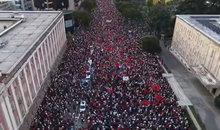
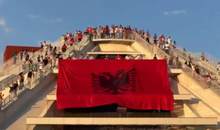

Video/ Marjana Koçeku leaves the SP and joins the protest against Rama
2026-06-20 20:19:13
Why are Albanian couples postponing the decision to have their first child?
2026-06-20 20:07:54

Protester to Rama: The first point of the contract is not to be you
2026-06-20 19:20:30

"Heart in Albania", New York Albanians protest against Rama
2026-06-20 18:42:34
Diaspora convoy parades past Rama's office
2026-06-20 18:25:08
Tensions rise, Iran closes the Strait of Hormuz
2026-06-20 18:06:21
A ndikojnë syzet e diellit te hormonet? Ekspertët shpjegojnë çfarë thotë shkenca
2026-06-20 17:42:37
Severe heat wave over the weekend, temperatures reaching up to 39°C
2026-06-20 16:53:08

Switzerland confirms Iran-US talks are continuing
2026-06-20 16:11:07
Diaspora convoy arrives in Tirana, hundreds of cars enter the capital
2026-06-20 15:49:35

Fire in Karaburun, smoke invades the coastline
2026-06-20 14:54:48
Immigrants join the protest, kilometer-long convoy crosses Albania
2026-06-20 14:42:48
Balluk's driver's testimony: The villa in "White Rocks" belonged to the "boss"
2026-06-20 14:20:22

Malësi e Madhe/ 306 narcotic plants destroyed, two people arrested
2026-06-20 13:43:55
7 daily habits that are damaging your brain health
2026-06-20 13:23:06



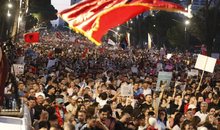
Protesta e 21-të për largimin e Ramës, sot diaspora
2026-06-20 11:44:33
After warning residents, Kakomë's perimeter fence is removed
2026-06-20 11:19:09
Money Laundering, Tobacco: They are destroying the middle class
2026-06-20 11:00:31
He distributed cocaine in various areas of Tirana.
2026-06-20 10:46:52
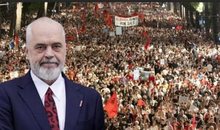
Protests against Rama, a group of MEPs urgently arrive in Albania
2026-06-20 10:01:38
Accident on the Levan-Vlora axis, traffic on the highway is heavy
2026-06-20 09:38:39
PS mbledh sot Grupin Parlamentar
2026-06-20 09:17:16


A scorching sunny weekend, here's what the temperatures will be like
2026-06-20 08:25:45
Morning Post/ In 2 lines: What mattered yesterday in Albania
2026-06-20 08:01:56

Erion Isai's wiretaps/How millions were stolen from the Erseka municipality
2026-06-19 21:26:42
Portugalia kërkon pasuesin e Martínezit, Mourinho del nga gara
2026-06-19 21:07:18
Albania has the highest price for a basic mobile internet package in the Region
2026-06-19 20:48:07
Why people who enjoy solitude are often more self-aware and emotionally strong
2026-06-19 20:28:18
Gjendet i pajetë 62-vjeçari në liqenin e Viroit
2026-06-19 20:03:24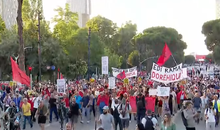
“Rama jep dorëheqjen”, protestuesit marshojnë drejt Kryeministrisë
2026-06-19 19:44:36
Zvicra konfirmon shtyrjen e bisedimeve SHBA-Iran
2026-06-19 19:35:12

Why always saying "YES" at work can turn into a trap
2026-06-19 18:48:46
Fatal accident in Fier-Lushnje, a 35-year-old man loses his life
2026-06-19 18:31:12
Tragedy with two minors in Tale, beach without security guards
2026-06-19 17:57:50

Accident on the Lezhë-Milot highway, 3 injured
2026-06-19 17:20:53
Is climate change strengthening the El Niño phenomenon?
2026-06-19 16:59:07
Israel and Hezbollah reach ceasefire agreement
2026-06-19 16:45:03
DP requests urgent interpellation with Rama regarding the protesters' 5 demands
2026-06-19 16:28:41
How prepared is the Albanian economy for the European market?
2026-06-19 15:55:28
Fight in Ali Demi area, one injured with a knife
2026-06-19 15:35:09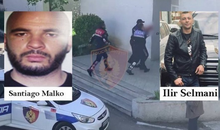
Murder of Santiago Malko, Special Appeal leaves Ilir Selmani under house arrest
2026-06-19 15:20:57
Two children drowned while bathing in the sea on Tale beach
2026-06-19 15:05:03
The 2026 World Cup "reds" early, red cards towards a historic record
2026-06-19 14:46:45
Albanian Language and Literature results for the 2026 Matura exam are published
2026-06-19 14:30:48




Two words about the boastful MP
2026-06-19 12:15:43

Mexico beats South Korea, advances to World Cup knockout stage
2026-06-19 10:57:14

The Transparency Board ceases to function
2026-06-19 10:17:33
Drought and flooding, scientists warn of the strongest El Niño in 140 years
2026-06-19 09:44:28

Oil in Albania costs 10.5% more than the European average
2026-06-19 09:09:11
Foreign exchange, June 19, 2026
2026-06-19 08:49:46
Protests/ Italian MEP criticizes Rama: Don't ignore citizens' demands
2026-06-19 08:27:27
With stable weather conditions, check out today's weather forecast
2026-06-19 08:12:37
Morning Post/ In 2 lines: What mattered yesterday in Albania
2026-06-19 07:55:49
Edhe makineritë e pajisjet në Shqipëri u kushtojnë bizneseve më shumë se BE
2026-06-18 22:53:17




EU announces strategic discussion on enlargement
2026-06-18 21:10:57
Brazil without Neymar in second World Cup match, striker rested
2026-06-18 20:54:31
Photo/ The moment when Rama's escort quickly leaves the crowd of protesters
2026-06-18 20:12:46