
 Flash News
Rama attacks international media: Why do you make a protest with 2,000 people so dramatic?
Protester suffering from cancer explodes: Oncology, Auschwitz in the middle of Tirana
MEP warns: If Albania stays outside the EU, you will be in the hands of China and Russia
MEP: Everyone is in favor of Albania in the EU, but can we have Rama in the European Council?
Accident on the Pogradec-Qafë Thanë axis, two injured
Revival of the military industry, a need for changes in the security climate in Albania

Politiko
2025-02-18 19:14:02
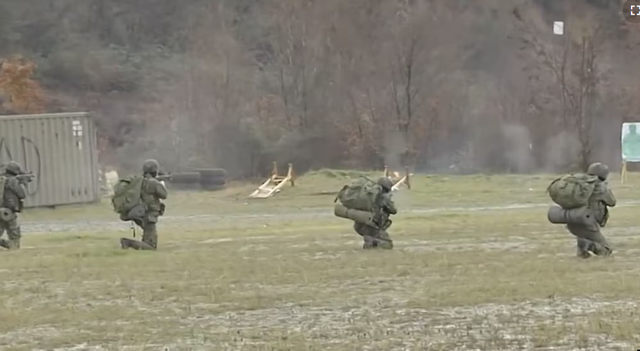
In Albania, the reactivation of the military industry is seen by official authorities as a function of changes in the global security environment. The invasion of Ukraine 3 years ago by Russia brought a new perspective, according to them, on the defense policies of NATO countries. Albania inherited from the communist regime a considerable amount of weapons and ammunition that took many years to destroy, while their production plants ceased to exist after the 90s. Officials say that the revival of this industry will initially bring about the fulfillment of the needs of the Albanian army with weapons and ammunition and in a second phase their export.
The revival of the military industry was defined by Prime Minister Edi Rama, alongside the EU Enlargement Commissioner, in February 2024 after the visit of the President of Ukraine, Volodymyr Zelensky, to Tirana. A few months later, the government and parliament approved the legal framework for the exercise of the production activity of the military industry, for the needs of the armed forces, in support of the Alliance, but also for future profit purposes, as official authorities argue. The Director of the Defense Industry Agency told Voice of America that the needs of the armed forces are mainly for armaments and ammunition, while explaining why this process is happening now.
"The geostrategic environment has also changed, more reserves are required. There are more Alliance operations in support of its mission, but the government's approach has also changed because we are now oriented towards minimizing defense spending. So since we are spending more on defense, let's contribute to reducing defense spending," says Dorian Tola, director of the Defense Industry Agency.
The military industry until 1990 was based on three factories, the Polican Mechanical Plant, which produced ammunition, and the Gramsh and Mjekës Factories, which produced weapons and explosives, respectively. During the communist regime, militarization was a priority of the leadership at the time.
The amount of ammunition and weapons, according to experts, reached high figures for a small country like Albania, and in the 90s after the fall of this regime, ammunition alone was estimated at approximately 298 thousand tons. And precisely at this time, even with the new role of the Albanian army after the democratic transformations and its commitment to NATO membership, this industry ceased to function. The destruction of weapons and ammunition was now the main focus. Dismantling began in the 2000s, but according to officials, this process was introduced into full legal frameworks in 2009, a year after an explosion in an ammunition dismantling factory in the village of Gërdec, 16 km from the capital, killed 26 citizens and injured hundreds more.
"From 2009 to 2019, which is considered the end of mass destruction, the total amount destroyed through all three types of processes, namely industrial dismantling, in polygons and sale, was about 105 thousand tons of ammunition. The sale of ammunition accounts for about 20%, but weapons have also been sold. In 2014, we also began the process of destroying excess weapons. From this year to today, about 90 thousand small and light weapons, which are considered infantry weapons, may have been destroyed at the Gramsh Mechanical Plant," Bledar Horanlliu, property management specialist at the Ministry of Defense, tells Voice of America.
The new legal package for the production of weapons and ammunition regulates the exercise of this activity also for foreign investors, who may or may not create a partnership in production with the newly established state-owned company KAYO, for a wide range of military goods, from ammunition of various calibers to advanced technologies. The defense budget according to NATO commitments reaches 2.01% of Gross Domestic Product.
Meanwhile, the authorities of the Ministry of Defense have made the relevant assessments and have reached the financial conclusion that the reconstruction of the three factories would cost the state budget half of the annual budget for the defense sector, or 250 million euros, a figure considered high by the authorities.
"The defense industry is very costly, and to develop it requires significant commitments from Albanian taxpayers. For this reason, the best solution is seen as creating a suitable climate for making investments in Albania, with the aim of meeting the needs of the armed forces, reducing the costs of reactivating this industry and supplying the market according to concrete needs," continues Dorian Tola, director of the Defense Industry Agency.
Mr. Tola clarifies some important details of the future export of weapons and ammunition, in relation to NATO and its defense policies.
"The legislation prohibits exports to third countries whose policies are contrary to our national and NATO interests," explains Mr. Tola.
Experts conclude that the infrastructure of the three current weapons and ammunition production plants is completely depreciated and out of function, and on the other hand they support the initiative to revive the military industry.
"The possibility that the part of the machinery and equipment can be reused is zero, because the depreciation is complete. Only the territory and facilities can be used if they are evaluated by specialists who can
"The government must promote the initiative for the production of weapons and ammunition in the new conditions we are in today and the needs we have, based on what other Balkan countries are doing," Esat Koçi, an expert on ammunition control and production, told Voice of America.
Countries in the region have made progress in this direction, while the military industry has been completely dormant for more than 30 years. Its revival is seen with optimism but also with skepticism by experts in the field due to high costs. VOA
Latest news

How to save money during summer vacation?
2026-06-06 21:30:03

Luxembourg punishes Albania in the 8th minute
2026-06-06 20:39:18
Teacher in protest: Gratitude to Trump and the US for uprooting the Sorosites
2026-06-06 20:17:53


Putin rejects Zelensky's proposal for a meeting
2026-06-06 18:39:37
Germany on alert, Neuer in doubt for World Cup
2026-06-06 17:16:09
Even after the crisis, expensive oil remains a challenge for Albania
2026-06-06 16:52:57
Accident on the Pogradec-Qafë Thanë axis, two injured
2026-06-06 16:30:28
Albanians work 41 hours a week, but one hour of work produces only 995 lek
2026-06-06 16:12:47


Killed during the operation in Maliq, GoFundMe opens for Enea Mekolli's family
2026-06-06 15:24:24
WHO identifies future pandemic threats, what could threaten Europe
2026-06-06 15:05:34


Berisha: Rama is robbing the Gjipe canyon, using Ardit Bido to forge documents
2026-06-06 13:34:48




World Cup, Iranian players granted visas to enter the US
2026-06-06 12:07:25
After the Italy-Karaburun record, Eva Buzo swims across the island of Sazan
2026-06-06 11:34:07


TNT attack at night in an apartment in Lezha, the couple was inside
2026-06-06 09:44:24
Without doctors; Is Albania ready to face new pandemic threats?
2026-06-06 09:03:28
A car hits and kills a person on the Fier-Vlora highway
2026-06-06 08:44:31
Rising temperatures, weather forecast for today
2026-06-06 08:22:32
Morning Post/ In 2 lines: What mattered yesterday in Albania
2026-06-06 08:01:15

"Dad Brain", How Fatherhood Changes the Male Mind
2026-06-05 21:44:40
50 thousand undeclared euros seized at Durres customs
2026-06-05 21:25:48
A citizen married for 30 years in Tirana, institutions declare her single!
2026-06-05 21:19:51
Rama blames Trump's enemies for Zvërnec's echo: The man didn't shave...
2026-06-05 20:56:29
Guard rapes protester during Rama's meeting /VIDEO
2026-06-05 20:39:18
Protest against Rama also in Berlin
2026-06-05 20:14:09
Meta's lawyer: If Rama does not testify, the process is not complete
2026-06-05 20:01:14
How the US naval blockade has cost Iran $6 billion in oil revenue
2026-06-05 19:44:17

Even after the crisis, expensive oil still a challenge for Albania
2026-06-05 19:09:39
Kosovo Police Arrest Serbian List Activist
2026-06-05 18:50:39
Accident at Kombinat, car hits minor
2026-06-05 18:33:56
Rama clashes with Zvërnec resident: Who are you talking to?
2026-06-05 18:27:35
Von der Leyen: Albania should quickly follow Montenegro
2026-06-05 18:13:32
These zodiac signs will find love in June!
2026-06-05 18:01:33
Increased security for Rama's visit to Vlora
2026-06-05 17:46:32
The Rossoneri lose one place in the FIFA rankings
2026-06-05 17:32:56
Police remove 14 sea piers in Ksamil
2026-06-05 17:16:07
Urban accident near Tirana Court, several injured
2026-06-05 16:56:32
Belgium considers selling royal jewels to fill budget gaps
2026-06-05 16:45:02


Socialist MP Klevis Jahaj appears in SPAK
2026-06-05 16:01:00
Photo/ Hundreds of citizens bid farewell to Enea Mekolli
2026-06-05 15:39:58

Citizen puts knife to the neck of a street police officer
2026-06-05 15:03:38

A comparison of problematic projects in Belgrade and Zvërnec
2026-06-05 14:19:49
Berisha: We support the citizen protest for Zvërnec, but the DP is not involved
2026-06-05 13:29:19
Beautiful ugly protest
2026-06-05 13:10:56

Berisha: Enea Mekolli is a hero twice, his killer was financed with state funds
2026-06-05 12:25:45


Transparency Board sets new fuel prices
2026-06-05 11:38:15

The Director of the Albanian Railways, Ergys Verdho, appears again at SPAK
2026-06-05 11:02:56

Foreign exchange/ How much foreign currencies are bought and sold today
2026-06-05 09:49:44
From Rama's hands to the ministries, 16 institutions change their dependence
2026-06-05 09:37:06

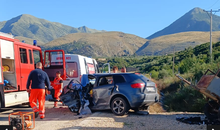
Two cars collide on the Kardhiq-Delvinë axis, one dead and 3 injured
2026-06-05 08:35:38
With alternating clouds, what is the weather forecast for today?
2026-06-05 08:20:50

Morning Post/ In 2 lines: What mattered yesterday in Albania
2026-06-05 07:57:11
Hasimja: Albania is losing a historic chance for EU integration
2026-06-04 22:57:39
US Senate confirms Eric Wendt as US ambassador to Albania
2026-06-04 22:30:33