The figures that bring down Rama/ How the flamingos disappeared with his coming to power
Politiko2026-06-10 13:00:12
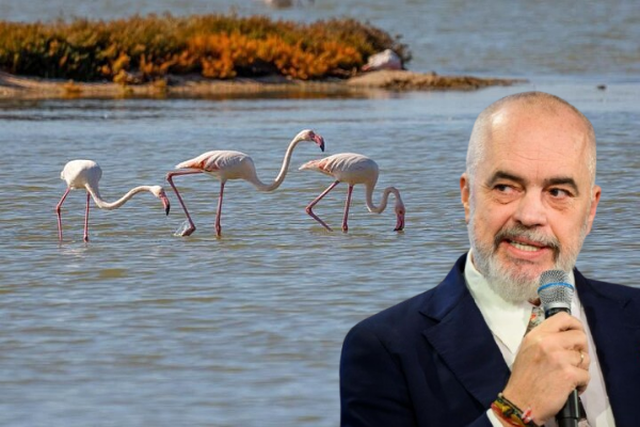
A statement by the Minister of State for Parliamentary Relations, Erjona Ismaili, that before the Socialist Party came to power there were no "flamingo seeds" was not taken seriously by environmentalists, even though it was addressed specifically to them.
"...Environmentalists, this lagoon that we are talking about today and are asking the government not to kill these flamingos and pelicans, there were not a single flamingo at that time. It took 12 years of initiatives for us to reach the diversity that we have today ," said Minister Ismaili.
But the support of this narrative by Prime Minister Edi Rama himself in a meeting with foreign journalists prompted the Ornithological Society of Albania, led by Professor Dr. Taulant Bino, to publish detailed data on the evolution of the wintering population of flamingos and the number of birds in Vjosa-Narta, both before and after the "Berisha" government, data that ornithologist Taulant Bino also made available to Faktoje.
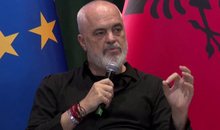
Raman
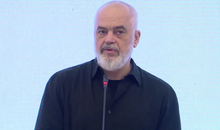
"Let's talk about the environment. Flamingos. Do you know when flamingos started returning to Albania? Because they weren't. When I came to government, when we took over the government, there were no flamingos there. Why? Because Albania was a hotbed of illegal hunting.
"We lost a lot of our wildlife due to illegal hunting, and meanwhile the flamingos, along with pelicans and others, started to return a few years after we imposed a moratorium in Albania, declaring illegal hunting illegal for 10 years," Rama said.
Albanian Ornithological Society (AOS)
"The Rama government found about 20,000 birds in Vjosa-Narta, of which 1,322 were Flamingos. In the years 2014-2026, the number of birds in Narta is lower than in 2013.
Flamingos have been fluctuating, however. They declined in 2015-2019, only to increase after 2020.
This government and none of the previous governments brought birds to Vjosa-Narta, although it is the obligation of governments to draft policies and take measures to preserve birds and their habitats.
"This obligation is even stronger for Albania's protected areas such as Pishë-Poro-Nartë, Divjakë-Karavasta, Butrint, Kune-Vain, etc.," the statement of the Ornithological Society of Albania states.
Table prepared by ornithologist Taulant Bino
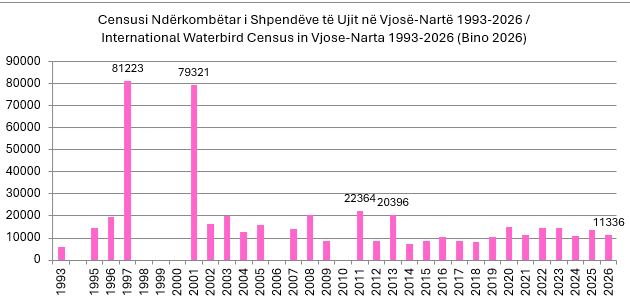
Birds
The graph above, according to environmental expert and lecturer Dr. Taulant Bino, presents the evolution of the total number of waterfowl recorded during the International Waterfowl Census (IWC) in the Vjosa-Nartë complex during the period 1993–2026.
The historical peak was recorded in 1997 with 81,223 birds, while an almost similar value was recorded in 2001 with 79,321. So, in the years 2014-2026, the number of birds in Nartë is lower than in 2013.
flamingos
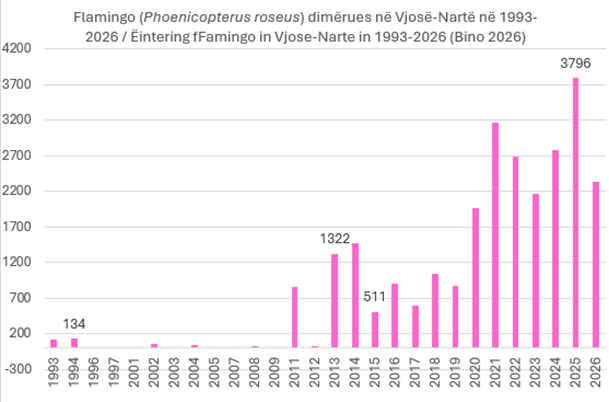
For flamingos wintering in the Vjosa-Narta complex during the period 1993–2026, the situation, according to AOS, is different with the highest increase in the number of flamingos in 2025.
Table prepared by ornithologist Taulant Bino
"During the period 1993–2009, the Flamingo was a relatively rare species in the area. A significant increase was recorded in 2011, when 857 individuals were counted, while in January 2013 the population reached 1322 individuals.
This period marks the beginning of more regular use of the Vjosa–Nartë complex by wintering Flamingos. The subsequent period, 2014–2026, is characterized by significant fluctuations in the number of individuals.
After the high value recorded in 2014 (1475 individuals), the population suffered a decline during 2015–2019, with numbers ranging from 511 to 1042 individuals.
"After 2020, an increase in the number of Flamingos is evident with 3796 individuals registered in 2025 ," the statement of the Ornithological Society of Albania states.