 Flash News
The boy killed the officer in Maliq, Violand Braçellari's mother speaks for the first time: The policeman shot first, he was not warned
Kosovo votes today for the new Parliament, over 2 million citizens eligible to vote
Morning Post/ In 2 lines: What mattered yesterday in Albania
Rama attacks international media: Why do you make a protest with 2,000 people so dramatic?
Protester suffering from cancer explodes: Oncology, Auschwitz in the middle of Tirana
How the 'Migjeni' theater became the scene of a clash between art and power

Politiko
2025-12-31 11:30:00
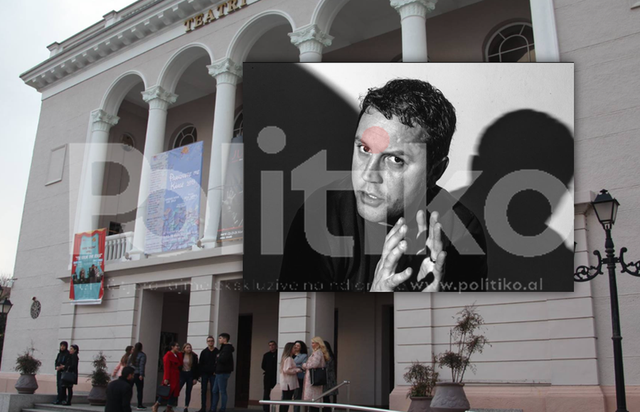
In the heart of Shkodra, the "Migjeni" Theater, a space for artistic performances and a historical symbol of the city's cultural identity, seems to be turning into an arena of conflict between art and power.
Recent cases related to the administration and reconstruction of this theater have sparked debate on the politicization of the artistic scene in Albania.
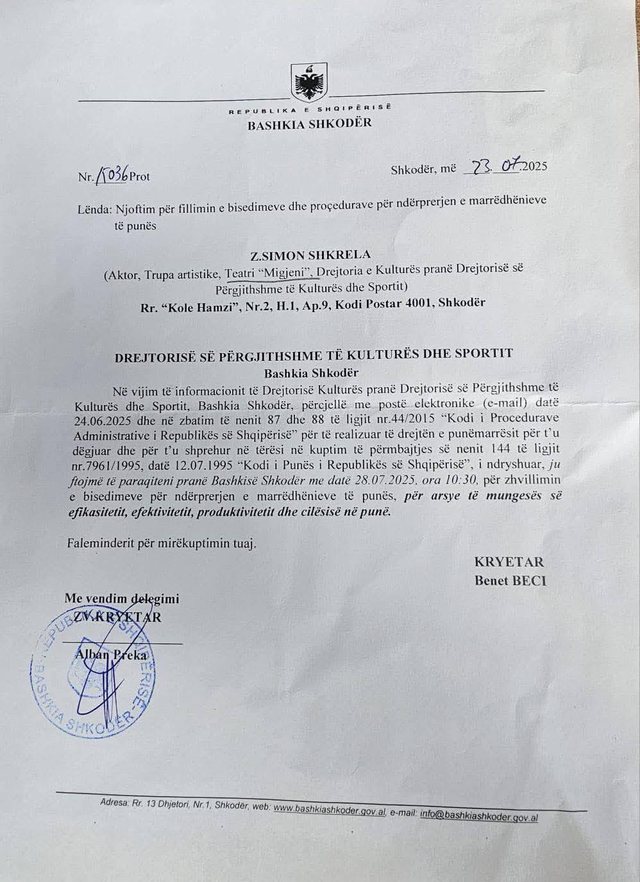
A few days ago, renowned journalist and actor Simon Shkreli was fired from the troupe of the "Migjeni" Theater, with the official motivation of "lack of efficiency, effectiveness, productivity and quality at work."
He described the decision as an act of political revenge, orchestrated by bureaucrats unrelated to art.
Engaged in theater since 2006, Shkreli considered his departure as part of a broader plan to exclude critical voices against the current administration.
The incident has sparked strong reactions and has been described by many as an act of political revenge. This is because Shkreli is also the husband of Eliona Shkreli, the president of the Democratic Party of Shkodra, and this political connection has been at the center of accusations about the motives for the departure.
Repeated case
The "Migjeni" Theater has been subject to interventions by local and central authorities, often without a transparent consultation process with the artists.
In January 2024, the Shkodra Municipal Council, with the support of Mayor Benet Beci, approved a decision to restructure the institutions under the municipality, including the "Migjeni" Theater.
This decision, considered by many actors and citizens as a step towards the dissolution of institutional autonomy, sparked a broad debate on the politicization of the cultural scene in Albania.
While the Municipality of Shkodra described it as a "restructuring for efficiency and maintenance", many public figures interpreted it as an attempt to strip the institution of its artistic identity and turn it into an extension of the local administration.
Director Rita Gjeka has expressed the need for a regulated relationship with power: "Politics cannot dominate the scene—it should support, not lead," she said.
Thus, Shkreli's dismissal and the restructuring of the theater are seen as part of a continuous line where the government seeks to control art and culture.
Shkreli's wife, Eliona Kodra, chairwoman of the Democratic Party in Shkodër, described the departure as "pure political revenge" by Benet Beci. This reinforces the perception that the art scene is turning into an ideological battlefield, where critical artists are penalized. In these conditions, art seems to be facing a new challenge: survival in a climate where the government seeks to dictate not only the budget, but also art.
Latest news

Armenians vote on country's future between East and West
2026-06-07 13:51:13
Former Republican Guard officer found dead in Mat River
2026-06-07 13:00:13
Strong tremors in Athens, two earthquakes one after the other
2026-06-07 12:41:55
Protest in Lushnje over hospital conditions: citizens denounce state negligence
2026-06-07 11:41:43
Tirana/ Over 1 kg of heroin seized, two arrested
2026-06-07 11:24:28


Elbasan's 22-year-old striker dies in accident
2026-06-07 09:47:09
Foreign exchange, the rate at which foreign currencies are sold and bought
2026-06-07 09:29:35
Albania, the automotive industry, between growth and loss of low-cost advantage
2026-06-07 08:54:15
Horoscope, get to know the star forecast
2026-06-07 08:34:25
Weather forecast, what are the temperatures expected to be like today?
2026-06-07 08:17:02
Morning Post/ In 2 lines: What mattered yesterday in Albania
2026-06-07 07:56:42
Aksident në aksin Fier–Levan, tre persona përfundojnë në spital
2026-06-06 21:57:40
How to save money during summer vacation?
2026-06-06 21:30:03
Luxembourg punishes Albania in the 8th minute
2026-06-06 20:39:18
Teacher in protest: Gratitude to Trump and the US for uprooting the Sorosites
2026-06-06 20:17:53


Putin rejects Zelensky's proposal for a meeting
2026-06-06 18:39:37


Germany on alert, Neuer in doubt for World Cup
2026-06-06 17:16:09
Even after the crisis, expensive oil remains a challenge for Albania
2026-06-06 16:52:57
Accident on the Pogradec-Qafë Thanë axis, two injured
2026-06-06 16:30:28
Albanians work 41 hours a week, but one hour of work produces only 995 lek
2026-06-06 16:12:47


Killed during the operation in Maliq, GoFundMe opens for Enea Mekolli's family
2026-06-06 15:24:24
WHO identifies future pandemic threats, what could threaten Europe
2026-06-06 15:05:34


Berisha: Rama is robbing the Gjipe canyon, using Ardit Bido to forge documents
2026-06-06 13:34:48



World Cup, Iranian players granted visas to enter the US
2026-06-06 12:07:25
After the Italy-Karaburun record, Eva Buzo swims across the island of Sazan
2026-06-06 11:34:07

TNT attack at night in an apartment in Lezha, the couple was inside
2026-06-06 09:44:24

Without doctors; Is Albania ready to face new pandemic threats?
2026-06-06 09:03:28
A car hits and kills a person on the Fier-Vlora highway
2026-06-06 08:44:31
Rising temperatures, weather forecast for today
2026-06-06 08:22:32
Morning Post/ In 2 lines: What mattered yesterday in Albania
2026-06-06 08:01:15
"Dad Brain", How Fatherhood Changes the Male Mind
2026-06-05 21:44:40
50 thousand undeclared euros seized at Durres customs
2026-06-05 21:25:48
A citizen married for 30 years in Tirana, institutions declare her single!
2026-06-05 21:19:51
Rama blames Trump's enemies for Zvërnec's echo: The man didn't shave...
2026-06-05 20:56:29
Guard rapes protester during Rama's meeting /VIDEO
2026-06-05 20:39:18
Protest against Rama also in Berlin
2026-06-05 20:14:09
Meta's lawyer: If Rama does not testify, the process is not complete
2026-06-05 20:01:14
How the US naval blockade has cost Iran $6 billion in oil revenue
2026-06-05 19:44:17

Even after the crisis, expensive oil still a challenge for Albania
2026-06-05 19:09:39
Kosovo Police Arrest Serbian List Activist
2026-06-05 18:50:39
Accident at Kombinat, car hits minor
2026-06-05 18:33:56
Rama clashes with Zvërnec resident: Who are you talking to?
2026-06-05 18:27:35
Von der Leyen: Albania should quickly follow Montenegro
2026-06-05 18:13:32
These zodiac signs will find love in June!
2026-06-05 18:01:33
Increased security for Rama's visit to Vlora
2026-06-05 17:46:32
The Rossoneri lose one place in the FIFA rankings
2026-06-05 17:32:56
Police remove 14 sea piers in Ksamil
2026-06-05 17:16:07
Urban accident near Tirana Court, several injured
2026-06-05 16:56:32
Belgium considers selling royal jewels to fill budget gaps
2026-06-05 16:45:02

Socialist MP Klevis Jahaj appears in SPAK
2026-06-05 16:01:00
Photo/ Hundreds of citizens bid farewell to Enea Mekolli
2026-06-05 15:39:58

Citizen puts knife to the neck of a street police officer
2026-06-05 15:03:38
A comparison of problematic projects in Belgrade and Zvërnec
2026-06-05 14:19:49
Berisha: We support the citizen protest for Zvërnec, but the DP is not involved
2026-06-05 13:29:19
Beautiful ugly protest
2026-06-05 13:10:56
Berisha: Enea Mekolli is a hero twice, his killer was financed with state funds
2026-06-05 12:25:45