
 Flash News
Murder of Martin Cani, Appeal upholds 16-year prison sentence for Mario Përlleshaj
5 'barber houses' discovered in Lezha, two in handcuffs, 4 OSHEE employees prosecuted
EU auditors 'blacken' Albania: Transport projects, slow and unattended
Foreign exchange, how much lek is used to buy and sell major currencies today
"La Roja" strikes first! Spain takes advantage over "The Roosters"
On the phone all day, but the digital skills of young Albanians are among the lowest in Europe

Politiko
2026-07-15 12:22:16
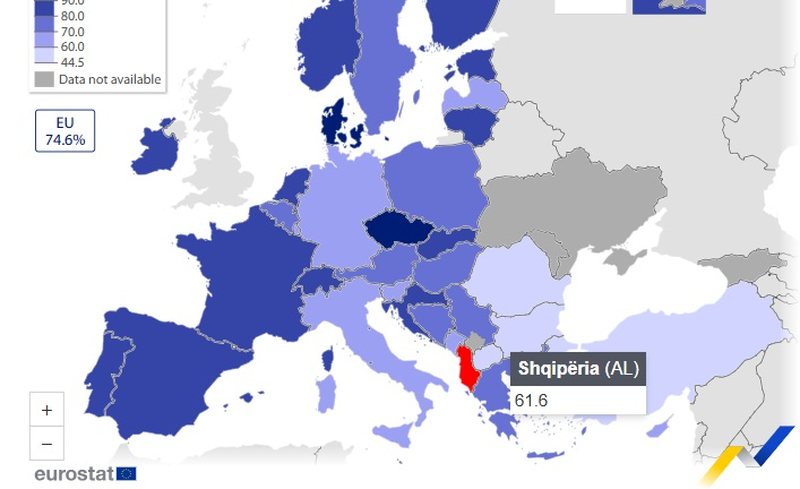
The digitalization of administration, the expansion of e-commerce, and the growing demand for technology-related professions are making the mastery of digital skills increasingly essential for entering the labor market.
The widespread use of smartphones and social networks does not necessarily translate into full mastery of the skills required in education, employment, and the use of online public services, at least for young Albanians.
The latter remain among the least prepared in Europe in this regard, while they seem to use technology more to spend time on social networks.
Only 61.2% of young Albanians aged 16-24 had at least basic digital skills, according to the latest available data for Albania, published today by Eurostat. This level places the country among the worst-performing economies in Europe and significantly below the European Union average of around 75%.
In the region, Albania is only behind North Macedonia, where only 44.5% of young people had at least basic digital skills. Montenegro performs slightly better than Albania, with 62.4%, while Bosnia and Herzegovina reaches 70.8%.
The results are significantly higher in Serbia, where 77.1% of young people possess basic digital skills. Serbia not only leads the Western Balkans, but also ranks above the European Union average.
The data for Albania and the countries of the region in the graph refer to 2024, while the latest Eurostat figures for the European Union countries are for 2025.
How are digital skills measured?
The digital skills indicator is a composite index that measures the concrete activities performed by individuals while using the internet and computer programs.
The measurement, according to Eurostat's methodology, includes five main areas: finding and processing information and data; communicating and collaborating online; creating digital content; security in the online environment; and solving technological problems.
A person is considered to have at least basic digital skills when they have performed at least one activity in each of these five areas. Eurostat assumes that performing a certain activity indicates that the individual possesses the relevant skill.
These skills may include, among others, searching for and evaluating information online, sending messages or participating in social networks, creating and editing documents, protecting personal data, and installing or using applications.
Three in four young people in the EU have basic digital skills
In 2025, around 74.6% of young people aged 16-24 in the European Union had at least basic digital skills. Compared to this average, Albania is around 13 percentage points below.
Denmark recorded the highest level in the EU, with 92.1% of young people possessing basic digital skills. It was followed by the Czech Republic with 91.7% and Malta with 91.5%.
High results were also recorded in Finland, with 89.9%, Croatia with 89.1%, the Netherlands with 88.5% and Ireland with 85.5%.
At the bottom of the EU member states' rankings were Romania and Bulgaria. Only 53.3% of young Romanians and 52.8% of young Bulgarians had at least basic digital skills. These were the only two European Union countries where the indicator remained below 60%.
Young European women have more digital skills
Eurostat data also shows that young girls and women in the EU are performing better than their male peers. In 2025, 75.9% of young women aged 16-24 had at least basic digital skills, compared to 73.3% of young men.
This pattern was observed in 22 of the 27 European Union countries. The largest difference in favor of young women was recorded in Cyprus, with 18.8 percentage points, followed by Slovenia with 11.6 points and Austria with 9.1 percentage points.
Only in five EU countries did young men score higher. The biggest differences in their favor were recorded in Malta and Romania./ Monitor
Latest news



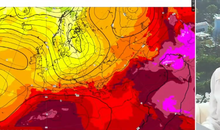
Meteorologist's warning: From tomorrow, temperatures above 40 degrees
2026-07-15 11:20:25
The u-Albania portal opens, high school graduates begin data verification
2026-07-15 11:04:48


Spain took France 'home', President Macron reacts: Painful defeat!
2026-07-15 10:06:50

Queues, chaos and water shortage, BIRN: Unhappy fans at Kanye West concert
2026-07-15 09:39:33
EU auditors 'blacken' Albania: Transport projects, slow and unattended
2026-07-15 09:31:26

Mbappe admits failure: Spain was better, we didn't play as we should have
2026-07-15 09:04:45
Foreign exchange, how much lek is used to buy and sell major currencies today
2026-07-15 08:28:27
DP convenes National Council today, new leadership team elected
2026-07-15 07:47:58

What is the weather forecast for today?
2026-07-15 07:15:06
Morning Post/ In 2 lines: What mattered yesterday in Albania
2026-07-15 07:01:00
Oyarzabal hyn në histori! Barazon rekordin legjendar të Butragueños
2026-07-14 22:13:12

"La Roja" strikes first! Spain takes advantage over "The Roosters"
2026-07-14 21:40:00
Police provide details from the accident in Cërrik: Two victims and one injured
2026-07-14 21:19:27

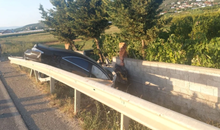
Tragic accident in Cërrik, two cars collide head-on, suspected victims
2026-07-14 19:34:00


Zhupa: Rama is defending concreting, not protected areas
2026-07-14 18:47:00

SPAK sends former mayor of Divjaka, Fredi Kokoneshi, for trial
2026-07-14 17:44:07

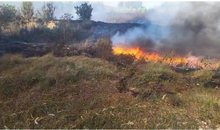
Fire near the village of Novoselë, flames approaching homes
2026-07-14 16:57:08
Dictators don't rise alone.
2026-07-14 16:20:00
The graves that Albania has not yet found
2026-07-14 15:40:44

Detoured twice, how the London-Tirana flight turned into a 12-hour nightmare
2026-07-14 14:14:18


The absolute loneliness of women who are "reborn"
2026-07-14 13:40:06
Why are healthy young non-smokers developing lung cancer?
2026-07-14 13:26:53
Why did the Bank of Albania revoke the licenses of 80 foreign exchange offices?
2026-07-14 13:14:00
Arson cases, 29 people arrested and prosecuted in June and July
2026-07-14 13:05:16

Accident at Liqeni i Thatë, young man on motorbike is hit by a vehicle
2026-07-14 12:45:43
INSTAT: Albanian women are aging faster than men, median age exceeds 45 years
2026-07-14 12:21:00


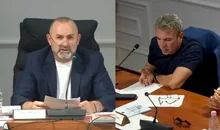
"Get out", Gjiknuri and Manja clash over the draft law on agricultural lands
2026-07-14 11:24:00
Injuring of 22-year-old in Fushë-Krujë, perpetrator arrested
2026-07-14 10:55:08

A pine forest area in Vlora is engulfed in flames, several homes are at risk
2026-07-14 10:28:04
World Cup turns into nightmare for Senegal, sexual harassment allegations raised
2026-07-14 10:20:12




Speaking multiple languages can keep your brain up to 13 years younger
2026-07-14 09:35:11
Strait of Hormuz becomes key battleground again, oil prices rise
2026-07-14 09:20:09

73.4% of Albanians' out-of-pocket health expenses go to medicines
2026-07-14 09:02:28
Over 10,000 dead from extreme heat wave in Europe, elderly most affected
2026-07-14 08:59:36

Foreign exchange, the rate at which foreign currencies are sold and bought
2026-07-14 08:24:50
The ten challenges Spain must win to eliminate France and Mbappé
2026-07-14 08:04:02



Morning Post/ In 2 lines: What mattered yesterday in Albania
2026-07-14 07:00:35
Ukraine strengthens air defense, Macron announces deal for 16 Rafale jets
2026-07-13 22:26:00
Shkullaku: Qeveria përdori koncertin e Kanye West për të eklipsuar protestën
2026-07-13 22:11:36
Conflict between young people in Fushë-Krujë, 22-year-old injured with knife
2026-07-13 21:47:26

Haaland, the phenomenon of the 2026 World Cup
2026-07-13 20:19:12
Citizens take to the streets again, protest enters 44th day
2026-07-13 20:01:25