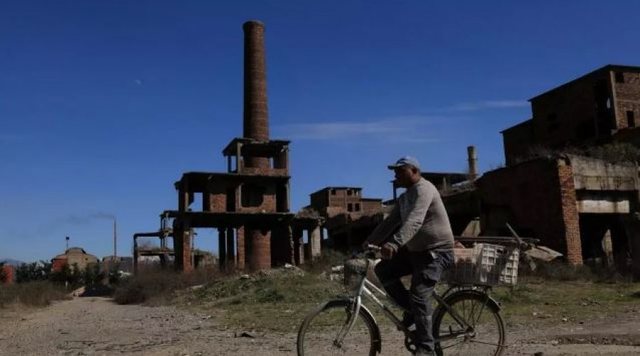
Once the pride of Albania's communist regime, Elbasan's giant metals complex is now one of the most polluted sites in the Balkans, laden with hundreds of thousands of tons of waste, much of it hazardous.
Built in the 1970s with Chinese assistance, the vast "Party Steel" shipyard once employed 10,000 workers in 500 factories during the dictatorship of Enver Hoxha.
Now only a tenth of that number work in the privatized factories that have survived, with everything that could be sold being removed from the ruins of the rest.
Despite the dangers and the stench, anyone can enter large areas of it, and many make a living by cleaning up piles of hazardous waste, searching for metals to resell.
"This is an area where 1.5 to two million tons of hazardous waste have been stored for more than 35 years, polluting the water, air and soil," Beqir Kila, a prominent Albanian environmental activist and engineer, told AFP.
Analyses conducted by various independent expert groups showed levels of lead, nickel and chromium at least three times higher than European limits, he said.
The Albanian Environmental Agency said the complex, just five kilometers (three miles) from the city of Elbasan, tops the list of "high-risk areas, with a high potential for pollution from heavy metal residues such as ferronickel and ferrochrome, a legacy that continues to pollute the waters of the Shkumbin River", in a report published in January.
However, the authorities are not proposing any solutions, environmentalists warn.
"Stored in the open air, at the mercy of atmospheric conditions, this waste undergoes changes and all the dangerous and toxic elements it contains penetrate the soil and water," warned Kila, pointing to his hands covered in black dust.
For years, the area in Albania's fertile central valley has been haunted by reports of high rates of cancer and birth defects.
"Lead emissions have caused brain failure, especially in children, but also genetic problems in cattle and poultry," Kila said.
'Catastrophic pollution'
The steel mills have long insisted they are following the rules, but neither they nor the Albanian government responded to AFP's requests for comment.
"We consider the pollution in the industrial area of the former Elbasan steel complex catastrophic," said environmental expert Ahmet Mehmeti.
In addition to problems from old, dilapidated factories, many of which are at risk of collapse, there is also pollution from new factories, he warned.
Official figures for air pollution around Elbasan do not exist, and air quality assessments are made by the factories themselves.
"The secret game with the authorities suits companies perfectly," Mehmeti said, as they are interested in reducing costs and not pollution levels.
An AFP team saw a chimney spewing black smoke at the site. But when a cameraman with a drone arrived, the smoke suddenly stopped.
"The waste contains chromium, nickel, zinc... the discharges pass into the water, flow into the nearby river, which is used to irrigate the land and ends up in fruits and vegetables on our plate," said Mehmeti.
Albania exports hazardous and non-hazardous waste that is not left in the country, as it is unable to treat it itself.
Last July, a total of 102 containers filled with waste left Albania for Thailand, where they would be recycled.
But after a whistleblower reported that the waste was suspected to be toxic and had not been registered as such, it was returned and has been in Albania since November.
"Albania has a law on the export of hazardous and non-hazardous waste, but the problem lies in the lack of control over procedures and documents," said environmental activist Lavdosh Ferruni.
The public prosecution office at the port of Durres has opened an investigation with the European Anti-Fraud Office (OLAF) into the case.
Meanwhile, suspected toxic waste remains in Albania./ France 24.
Latest news
"Dad Brain", How Fatherhood Changes the Male Mind
2026-06-05 21:44:40
50 thousand undeclared euros seized at Durres customs
2026-06-05 21:25:48
A citizen married for 30 years in Tirana, institutions declare her single!
2026-06-05 21:19:51
Rama blames Trump's enemies for Zvërnec's echo: The man didn't shave...
2026-06-05 20:56:29
Guard rapes protester during Rama's meeting /VIDEO
2026-06-05 20:39:18
Protest against Rama also in Berlin
2026-06-05 20:14:09
Meta's lawyer: If Rama does not testify, the process is not complete
2026-06-05 20:01:14
How the US naval blockade has cost Iran $6 billion in oil revenue
2026-06-05 19:44:17
Even after the crisis, expensive oil still a challenge for Albania
2026-06-05 19:09:39
Kosovo Police Arrest Serbian List Activist
2026-06-05 18:50:39
Accident at Kombinat, car hits minor
2026-06-05 18:33:56
Rama clashes with Zvërnec resident: Who are you talking to?
2026-06-05 18:27:35
Von der Leyen: Albania should quickly follow Montenegro
2026-06-05 18:13:32
These zodiac signs will find love in June!
2026-06-05 18:01:33
Increased security for Rama's visit to Vlora
2026-06-05 17:46:32
The Rossoneri lose one place in the FIFA rankings
2026-06-05 17:32:56
Police remove 14 sea piers in Ksamil
2026-06-05 17:16:07
Urban accident near Tirana Court, several injured
2026-06-05 16:56:32
Belgium considers selling royal jewels to fill budget gaps
2026-06-05 16:45:02
Socialist MP Klevis Jahaj appears in SPAK
2026-06-05 16:01:00
Photo/ Hundreds of citizens bid farewell to Enea Mekolli
2026-06-05 15:39:58

Citizen puts knife to the neck of a street police officer
2026-06-05 15:03:38
A comparison of problematic projects in Belgrade and Zvërnec
2026-06-05 14:19:49
Berisha: We support the citizen protest for Zvërnec, but the DP is not involved
2026-06-05 13:29:19
Beautiful ugly protest
2026-06-05 13:10:56
Berisha: Enea Mekolli is a hero twice, his killer was financed with state funds
2026-06-05 12:25:45
Transparency Board sets new fuel prices
2026-06-05 11:38:15

The Director of the Albanian Railways, Ergys Verdho, appears again at SPAK
2026-06-05 11:02:56

Foreign exchange/ How much foreign currencies are bought and sold today
2026-06-05 09:49:44
From Rama's hands to the ministries, 16 institutions change their dependence
2026-06-05 09:37:06

Two cars collide on the Kardhiq-Delvinë axis, one dead and 3 injured
2026-06-05 08:35:38
With alternating clouds, what is the weather forecast for today?
2026-06-05 08:20:50

Morning Post/ In 2 lines: What mattered yesterday in Albania
2026-06-05 07:57:11
Hasimja: Albania is losing a historic chance for EU integration
2026-06-04 22:57:39
US Senate confirms Eric Wendt as US ambassador to Albania
2026-06-04 22:30:33


Andoni Iraola is officially Liverpool manager
2026-06-04 20:52:27
Killed in the line of duty, family refuses to bury officer in Martyrs' Cemetery
2026-06-04 20:26:26


EU to provide $116 million in aid to Lebanese army
2026-06-04 18:12:12
Plane crashes in Croatia, at least 4 dead
2026-06-04 16:31:32
Berisha: Lands in Zvërnec were seized by Pjerini from Lezha and Agaç from Berat
2026-06-04 16:26:52
Minatorët e Bulqizës vijojnë bojkotin e punës, kërkojnë rritje pagash
2026-06-04 16:17:31

Former Montenegrin police chief banned from entering Serbia
2026-06-04 16:05:34
The moment when Gjesti enters the record company's offices armed
2026-06-04 15:03:29

The Euro-Lek exchange rate falls again, heading towards the threshold of 95 Lek
2026-06-04 14:33:00

Balluk's wealth "collapses", SPAK seizes his villa in Dhërmi
2026-06-04 14:00:13
Watermelon, the heart's ally in summer
2026-06-04 13:56:33
The board continues to "ping pong" with fuel prices, oil increases again
2026-06-04 13:39:24
Bardhi asks Rama to the Assembly: The interpellation is not delegated!
2026-06-04 13:21:54
House of Representatives approves measure to end Iran war
2026-06-04 13:14:35
Car ends up in canal, residents save father and son
2026-06-04 12:55:58
SPAK requests 98 years in prison for Durim Bami, Aldo Avdyli and 5 others
2026-06-04 12:39:43


Video/View from the scene where the policeman was killed in Maliq
2026-06-04 11:52:46

SPAK knocks on Igli Tare, former footballer included in Balluku file
2026-06-04 11:16:36