Brussels turns a blind eye as the Albanian narco-state threatens Europe
Nën drejtimin e kryeministrit Edi Rama, Shqipëria është shndërruar në një narko-shtet gjatë dhjetë viteve të fundit. Rrjetet kriminale shqiptare janë gjithnjë e më aktive nëpër Europë. Megjithatë, Bashkimi Europian vazhdon të mbështesë përpjekjet e Ramës për anëtarësim.

Politiko
2025-11-06 10:04:27
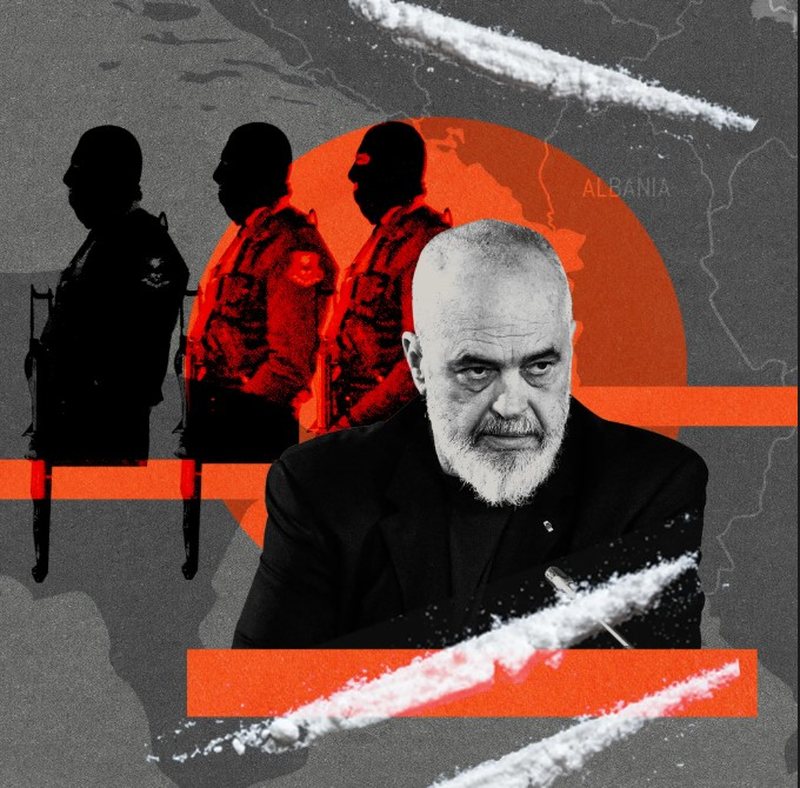
Antoine Harari/ Follow the Money
Article in one minute:
What is happening?
-Organized crime groups in Albania have become significantly more powerful in recent years.
-They have extended their influence to the judicial system and the government, according to a former senior government official and a police officer who have fled the country.
-At the European level, the Albanian mafia is gaining ground from Germany and the Netherlands to Spain, specialized officers and investigators have told Follow the Money.
-A joint investigation by Follow the Money and media partner BLAST shows that current Prime Minister Edi Rama has done little to curb the influence of these criminal organizations.
Why does it matter?
-With its ever-expanding network, the Albanian mafia has significantly increased the amount of drugs entering Europe, creating a security threat to the entire continent.
-The European Union is considering the possibility of Albania becoming a member state, while the president of the European Commission, Ursula von der Leyen, has been a strong supporter of Rama in recent years.
How was the investigation conducted?
-Follow the Money interviewed dozens of experts, police investigators, and former government officials, and
presented its findings to the Albanian government to confront the allegations and facts gathered.
It was a cold October night in the Mediterranean city of Fier, in southwestern Albania, when police stopped a black Audi A8.
For weeks, officers had been chasing suspected drug traffickers using the car. That night in October 2013, police inspector Dritan Zagani ordered his team to bring the vehicle to the police station. But once they got there, Zagani realized that catching them for drug smuggling wouldn’t be that easy – his superior forbade the officers from inspecting the car.
The problem? The car, according to reports, belonged to one of the most powerful people in the country, the Minister of Interior at the time, Saimir Tahiri.
"What I feared most has happened. My country has turned into a narco-state."
Instead of cracking down on the possible crime, prosecutors lashed out at Zagan: they accused him of exceeding his powers.
Now, more than 10 years later, from a safe place and with a new identity, Zagani explains how, during his decades in the Albanian police, he saw organized crime become increasingly intertwined with the state. Dressed in dark, plain clothes, with a hat lowered on his forehead, the former policeman speaks rapidly.
“What I feared most has happened,” Zagani told Follow the Money over coffee in a quiet courtyard in Switzerland earlier this year. “My country has become a narco-state.”
According to Zagan, the description of the Albanian mafia within the state is primarily the responsibility of the current Prime Minister, Edi Rama.
Rama secured an unprecedented fourth term for the Socialist Party in this year's national elections - elections that, according to observers, were marred by irregularities.
Part of Rama’s campaign was to portray himself as a pro-EU politician and defender of the rule of law. He has been a strong supporter of the fight against corruption and drugs, on the surface. In September, the government even created a minister for Artificial Intelligence, to make Albania “a country where public tenders are 100 percent free of corruption.”
But in reality, an investigation by Follow the Money in collaboration with partner media BLAST shows how organized crime groups have flourished during Rama's decade of rule - with disastrous consequences for the rest of Europe.
Europe has seen a significant increase in the amount of drugs being circulated by the Albanian mafia in recent years, as authorities have busted record smuggling operations.
In recent years, the Albanian mafia has expanded its networks abroad, while Rama has done little to curb the influence of criminal organizations, according to interviews with prosecutors, police, and experts.
Confidential documents, obtained by Follow the Money, support these claims.
This has caused major problems for Italy, where Albanian drug gangs are growing in influence. Meanwhile, it raises questions about why Brussels continues to support Tirana's bid for EU membership, despite the accusations against Rama and the country's failure to combat organized crime.
The prime minister's office has dismissed the corruption allegations as political attacks.
Government infiltration
Albania's economy makes the country vulnerable to organized crime groups.
“Criminal groups have penetrated all spheres of the state,” says Zagani.
About 20 percent of the population lives below the poverty line, approximately 30 percent of young people are unemployed, the average salary is around 600 euros per month, and the country continues to face difficulties in developing tourism.
Organized crime groups exploit this situation by investing money in cheap real estate for money laundering and using local companies as fronts.
“The Albanian mafia is extraordinarily gaining ground,” he says.
But, according to Zagan, the Albanian mafia's influence has gone beyond controlling local businesses – it has placed its key people in the government and the judicial system.
In Zagan's clash with the then Interior Minister, Saimir Tahiri, and his alleged drug trafficking network, Rama sided with Tahiri.
Only in 2019, two years after an investigation by the Italian Guardia di Finanza directly implicated the minister, was he sentenced to prison.
Zagani himself was released from prison, awaiting trial, after several months in detention in Tirana in 2015. He then fled to Switzerland, where he was granted asylum.
If Zagani were to ever return to Albania, he would most likely face prison again, having been sentenced in absentia to seven years in prison.
But this is not the only case where a close associate of Rama appears to have, at least initially, been shielded from criminal prosecution.
In early 2025, another former Minister of Interior of the country and Minister of State for Relations with Parliament, Taulant Balla, faced corruption charges.
During his tenure as minister, he was also the Socialist Party’s political leader for the diaspora. In this role, he was responsible for protecting the interests of Albanians abroad – but his associates were caught on wiretaps promising around €60 for every vote from the diaspora in the UK. With 2.5 million Albanians living abroad, the country has almost as many people abroad as within its borders.
Balla is well known to European police forces: his name emerged during a global investigation into the SKY ECC communications network. This operation, led by several European police agencies, aimed to target encrypted satellite phones used by criminals around the world to communicate.
After authorities gained access to the conversations, they discovered that Balla was in contact with drug traffickers, according to a portion of the transcripts published by local media outlet Lapsi.
The Prime Minister of Albania has defended Balla and kept him in office.
Manjola Hasa, a spokeswoman for the Albanian government, rejected any accusation that Rama had intervened unfairly in defense of his allies. “This is a mixture of insulting and ridiculous, because first of all, political accusations are not facts, and slander … cannot be used as a basis to continue smearing innocent people by violating their dignity,” she said.
However, allegations of corruption have not gone unnoticed by citizens: according to Transparency International's corruption perceptions index, the country currently ranks 80th out of 180 countries, making it one of the most corrupt countries in Europe.
Protection of Rama's associates
In January of last year, an opposition MP accused the prime minister's brother, Olsi Rama, of participating in the construction of a cocaine laboratory.
While Prime Minister Rama publicly came to his brother's defense, data from the country's border management system, obtained by Follow the Money, shows that Olsi Rama was driving a vehicle that was later identified as being used by a local mafia group.
In January of this year, SPAK, the Albanian anti-corruption structure, declared the prime minister's brother innocent, clearing him of all charges.
Meanwhile, in February 2024, former FBI agent Charles McGonigal was convicted in the United States of accepting a bribe of USD 225,000 from a close associate of Edi Rama, with the aim — according to the file — of investigating the Albanian prime minister's political rivals.
A thriving drug hub in Europe
While Albanian criminal groups thrive within the country, they have also extended their network throughout Europe, law enforcement officials told FTM.
“The Albanian mafia is extraordinarily gaining ground. Not only in terms of the volume of drugs they traffic or the number of people involved – but because of their ability to federate,” said a representative of the Guardia di Finanza’s organized crime investigation unit in Brescia and Rome, which has led several investigations into drug trafficking of Albanian origin. “From what we are seeing, they are at least as powerful as the Italian mafia.”
In Italy, for example, authorities have seized an increasing number of large quantities of cannabis and hard drugs linked to Albanian criminal groups.
Last September, Operation Tornado in Brescia, northern Italy, led to the arrest of over 60 people. The four-year investigation, involving more than 400 police officers, resulted in the seizure of 300 kilograms of cocaine worth over 60 million euros.
"All the bosses were Albanians. They ran everything from afar," said an Italian police officer involved in the operation.
At the head of the network was an Albanian organized criminal group, Italian authorities confirmed to Follow the Money.
The group laundered money through fake invoices, using a network of companies worth around 375 million euros, which circulated first in Eastern Europe, then in China, before returning to Albania, the police explained.
In March of this year, Italian police arrested four Albanians in Bologna, as part of an international anti-drug operation, suspecting them of smuggling cocaine, marijuana ,and hashish worth around 5 million euros from the Netherlands to Italy.
Authorities began to understand the true dimensions of the Albanian mafia in Europe during the investigation of the Sky ECC case, in which former minister Balla was also involved.
"We discovered that they were very active. They have logistical bases that stretch from Albania to Belgium, through Germany," said Nicolo Gratteri, an Italian prosecutor specializing in the fight against organized crime.
As a result of the extensive investigation that began in 2021, a series of court proceedings convicted over 1,000 people, while around 179 million euros were seized.
Shortly after the investigations began, members of the Albanian mafia placed a 1 million euro bounty on the head of a federal investigating judge in Belgium.
“Today these groups control the ports of Antwerp and Rotterdam,” said Italian prosecutor Nicolo Gratteri. “They can easily smuggle several hundred kilograms of drugs in a single route.”
In Belgium, all cannabis plantations are controlled by Albanian organized crime groups. In late April, for example, Belgian police raided a cannabis plantation reportedly run by an Italian-Albanian criminal group.
These are not isolated cases, and signs of Albanian dominance are increasing.
In its 2024 report, the European Union's law enforcement agency, Europol, identifies the Albanian mafia as one of the five most threatening criminal groups in Europe, both in cocaine and cannabis trafficking.
Along the same lines, Fatjona Mejdini, director of the South Eastern Europe Observatory at the Global Initiative Against Transnational Organized Crime, warns of the dominance of the Albanian mafia.
"They are one of the most threatening mafias in Europe," she said.
According to SPAK, the Albanian structure against corruption and organized crime, 16 separate Albanian criminal groups were active during that year.
Meanwhile, the UK's National Crime Agency (NCA) estimates that Albanian groups now control the majority of the British cocaine market - the largest in Europe.
Spain, one of the main entry points for cocaine from Latin America, has also seen a significant increase in seizures: in November 2024, 13 tons of cocaine linked to Albanian networks were seized in Algeciras – a historic record.
In 2023, Spanish authorities seized a total of 118 tons of cocaine, up from just 37 tons five years earlier.
According to the European Drug Agency, between 2012 and 2021, cocaine seizures at European ports increased by almost 400 percent. While the latest report from the UNODC (United Nations Office on Drugs and Crime) states that “the global supply of cocaine is at record levels.”
The court is not independent.
Zagani believes that the government has put pressure on the judicial system to convict him, and he is not the only one who thinks that the courts are not independent.
Under the presidency of Barack Obama, the US development agency USAID spent about $27 million to finance a reform aimed at separating politics from justice.
To this end, a new structure to investigate the most serious crimes – the Special Structure against Corruption and Organized Crime (SPAK) – was created in 2016. In theory, this was supposed to be a unit independent of the government and operate independently.
But this move had the opposite effect.
Although this structure was created to fight corruption, it seems that in practice it has allowed the prime minister to use the justice system as a political weapon: prosecutors undergo an evaluation process by a commission of people elected by parliament, most of whom are close to Rama and the Socialist Party.
“The country is completely gripped by corruption and is run by Rama and his inner circle,” former Deputy Prime Minister of Albania, Arben Ahmetaj, told Follow the Money.
Sitting on a small terrace in a quiet alley somewhere in Switzerland earlier this year, Ahmetaj – who had been part of the government from 2013 to 2022 – accused Rama of eliminating from the political scene anyone he saw as a threat to his power.
“Today, Rama's political rivals are prosecuted by the justice system – even those who dare to oppose him within his own party,” said the former Finance Minister, dressed in an olive-colored vest and with a thin cigar in his hand.
Ahmetaj was ousted from the government in July 2022, following a power struggle with the prime minister. He himself was later accused of corruption – charges that he said were fabricated by the government to tarnish his image. To date, the government has not presented any concrete evidence, while Ahmetaj insists on his innocence.
Like Zagani, Ahmetaj sought asylum in Switzerland in 2023 after learning that an arrest warrant had been issued for him in Albania. In his asylum application – in Switzerland, where his wife and daughter have residence permits – he claimed that the justice system had also intimidated his friends and family, conducting searches in their homes and offices.
Italian police sources support allegations of corruption and complain that the Albanian justice system has been infiltrated by organized crime.
“Whenever we need cooperation, we do our own verifications,” said a senior Italian police official who deals with organized crime, explaining that Italian police do not always trust Albanian counterparts to provide them with accurate or complete information.
SPAK did not respond to requests for comment.
Italian police in Albania
Italian police forces have been present in Albania since the mid-1990s, with a mission to crack down on international crime – but that does not mean that cooperation between Italian and Albanian police is smooth, the Italian official said.
According to him, the main problem lies in the low salaries of Albanian authorities, which make them susceptible to corruption.
"When you see a prosecutor who is supposed to earn 800 euros a month driving a Maserati, you immediately realize there is a problem," he added, without giving further details for confidentiality reasons.
Manjola Hasa, Rama's spokeswoman, dismissed the accusations. "This is another political accusation from Edi Rama's opponents, for which there is no fact," she said.
A profitable business model
Part of the Albanian mafia's success is explained by its unique economic model: it eliminated intermediaries and began to establish its operations directly in drug-producing countries.
Matt Shea, a British documentarian who has extensively investigated the Albanian cocaine trade, has interviewed both Colombian cartel leaders and members of the Albanian mafia.
“When I met with the Clan del Golfo,” he said of a paramilitary group believed to control most of Colombia’s cocaine production, “they told me that the Albanians were offering them a bigger share of the profits. Unlike the ‘Ndrangheta, which paid the standard price per kilogram, the Albanians proposed a 50-50 split.”
With the expansion of Albanian influence in Latin America, the cocaine route to Europe became even stronger.
According to Europol, the notorious trafficker Dritan Gjika sent tons of cocaine to Albania and several European ports. For this purpose, according to the Ecuadorian investigative media Plan V, he used the banana export company Agricomtrade, through which he hid the cocaine in shipments to Europe.
Coordinated raids in Ecuador and Spain led to the seizure of over 3 tons of drugs and financial assets worth 48 million euros.
In February last year, police raided Gjika's home in the port city of Guayaquil, and he has been on the run ever since.
But Gjika is not the only one using this scheme.
French author Stéphane Quere, who has written a book on the origins of Albanian organized crime, said that banana containers – often coming from Ecuador, a major exporter of the fruit – are a favorite place to hide drugs. The reason: inspecting them is difficult, because if the bananas spoil during inspection, port authorities have to cover the costs.
However, the numbers speak for themselves, Quere added.
“There are over 40 companies that import bananas to Albania,” he said wryly. “They must love bananas.”
Fearless
While police and prosecutors warn of the growing influence of the Albanian mafia in Europe, the continent itself seems to be turning a blind eye to this reality. Voices critical of Edi Rama remain rare.
On Tuesday, the European Commission published its assessment of Albania’s EU accession process, stating in a press release that the country had made “unprecedented progress” since last year – although the full report acknowledged that “corruption remains widespread in vulnerable sectors.”
One of Rama's strongest supporters has been the President of the European Commission, Ursula von der Leyen.
"Dear Edi... Albania is on the right path towards the European Union. I thank you for your work, dedication, and friendship," she said during a visit to Tirana in October 2024.
She was referring to the reform plans the Albanian government has undertaken to strengthen the rule of law and prepare for EU membership. “It is perfect,” she added of the reform plans.
Part of von der Leyen's continued support is explained by Albania's strategic importance. With a shared border with Greece and a narrow expanse facing the Adriatic, the small country has offered to help the EU by hosting refugees or rebuilding an air base for NATO.
Its messages of support are essential in Albania's membership process, which officially began in July 2022.
“Dear Edi, Albania is on the right track to becoming part of the European Union. I thank you for your work, dedication, and friendship,” she concluded her speech that October.
For former minister Arben Ahmetaj, this unwavering support from Europe remains inexplicable:
"I don't understand why Europe turns a blind eye to the reality of the situation in Albania," he said.
Latest news
"Dad Brain", How Fatherhood Changes the Male Mind
2026-06-05 21:44:40
50 thousand undeclared euros seized at Durres customs
2026-06-05 21:25:48
A citizen married for 30 years in Tirana, institutions declare her single!
2026-06-05 21:19:51
Rama blames Trump's enemies for Zvërnec's echo: The man didn't shave...
2026-06-05 20:56:29
Guard rapes protester during Rama's meeting /VIDEO
2026-06-05 20:39:18
Protest against Rama also in Berlin
2026-06-05 20:14:09
Meta's lawyer: If Rama does not testify, the process is not complete
2026-06-05 20:01:14
How the US naval blockade has cost Iran $6 billion in oil revenue
2026-06-05 19:44:17
Even after the crisis, expensive oil still a challenge for Albania
2026-06-05 19:09:39
Kosovo Police Arrest Serbian List Activist
2026-06-05 18:50:39
Accident at Kombinat, car hits minor
2026-06-05 18:33:56
Rama clashes with Zvërnec resident: Who are you talking to?
2026-06-05 18:27:35
Von der Leyen: Albania should quickly follow Montenegro
2026-06-05 18:13:32
These zodiac signs will find love in June!
2026-06-05 18:01:33
Increased security for Rama's visit to Vlora
2026-06-05 17:46:32
The Rossoneri lose one place in the FIFA rankings
2026-06-05 17:32:56
Police remove 14 sea piers in Ksamil
2026-06-05 17:16:07
Urban accident near Tirana Court, several injured
2026-06-05 16:56:32
Belgium considers selling royal jewels to fill budget gaps
2026-06-05 16:45:02
Socialist MP Klevis Jahaj appears in SPAK
2026-06-05 16:01:00
Photo/ Hundreds of citizens bid farewell to Enea Mekolli
2026-06-05 15:39:58
Citizen puts knife to the neck of a street police officer
2026-06-05 15:03:38
A comparison of problematic projects in Belgrade and Zvërnec
2026-06-05 14:19:49
Berisha: We support the citizen protest for Zvërnec, but the DP is not involved
2026-06-05 13:29:19
Beautiful ugly protest
2026-06-05 13:10:56
Berisha: Enea Mekolli is a hero twice, his killer was financed with state funds
2026-06-05 12:25:45
Transparency Board sets new fuel prices
2026-06-05 11:38:15

The Director of the Albanian Railways, Ergys Verdho, appears again at SPAK
2026-06-05 11:02:56

Foreign exchange/ How much foreign currencies are bought and sold today
2026-06-05 09:49:44
From Rama's hands to the ministries, 16 institutions change their dependence
2026-06-05 09:37:06
Two cars collide on the Kardhiq-Delvinë axis, one dead and 3 injured
2026-06-05 08:35:38
With alternating clouds, what is the weather forecast for today?
2026-06-05 08:20:50
Morning Post/ In 2 lines: What mattered yesterday in Albania
2026-06-05 07:57:11
Hasimja: Albania is losing a historic chance for EU integration
2026-06-04 22:57:39
US Senate confirms Eric Wendt as US ambassador to Albania
2026-06-04 22:30:33
Andoni Iraola is officially Liverpool manager
2026-06-04 20:52:27
Killed in the line of duty, family refuses to bury officer in Martyrs' Cemetery
2026-06-04 20:26:26

EU to provide $116 million in aid to Lebanese army
2026-06-04 18:12:12
Plane crashes in Croatia, at least 4 dead
2026-06-04 16:31:32
Berisha: Lands in Zvërnec were seized by Pjerini from Lezha and Agaç from Berat
2026-06-04 16:26:52
Minatorët e Bulqizës vijojnë bojkotin e punës, kërkojnë rritje pagash
2026-06-04 16:17:31
Former Montenegrin police chief banned from entering Serbia
2026-06-04 16:05:34

The moment when Gjesti enters the record company's offices armed
2026-06-04 15:03:29
The Euro-Lek exchange rate falls again, heading towards the threshold of 95 Lek
2026-06-04 14:33:00
Balluk's wealth "collapses", SPAK seizes his villa in Dhërmi
2026-06-04 14:00:13
Watermelon, the heart's ally in summer
2026-06-04 13:56:33
The board continues to "ping pong" with fuel prices, oil increases again
2026-06-04 13:39:24
Bardhi asks Rama to the Assembly: The interpellation is not delegated!
2026-06-04 13:21:54
House of Representatives approves measure to end Iran war
2026-06-04 13:14:35
Car ends up in canal, residents save father and son
2026-06-04 12:55:58
SPAK requests 98 years in prison for Durim Bami, Aldo Avdyli and 5 others
2026-06-04 12:39:43

Video/View from the scene where the policeman was killed in Maliq
2026-06-04 11:52:46
SPAK knocks on Igli Tare, former footballer included in Balluku file
2026-06-04 11:16:36