 Flash News
VIDEO-scandal in Saranda/ Director of AMP Vlora and officials sexually harass tourists
"The New York Times" about Ye's concert: How Rama justifies the $4.5 million in funding
The suspected perpetrator of the murder in Laç is identified, he shot the 40-year-old 7 times near the palace
7 bullets on the doorstep, who is the 40-year-old with 4 surnames who was killed in Laç
Morning Post/ In 2 lines: What mattered yesterday in Albania
Alfred Lela
A coordinated media formation has been mobilized around the meetings and political movements of former MP Ervin Salianji—once again demonstrating the familiar eagerness to sow division and widen fractures within the Democratic Party, a political trunk already struck by enough lightning over the years.
Some do it for sensationalism. Most operate under an editorial line that, if not explicitly financed, is clearly inspired and aligned with the interests of the government and its affiliated networks. The anti-opposition media reflex in Albania is not new—but never before, empowered by money, technology, and vested interests, has it been this aggressive or systematic.
What matters here is not the media as an institution, but the media as an extension of political power. And whether Salianji intends it or not, he becomes part of the same machinery—a tool in a government-framed narrative that diminishes the meaning, legitimacy, and potential of his political moves, however well intentioned or reformist they may be.
The reason is simple.
The central thesis of the government’s assault on the opposition is tied to its leader, Sali Berisha—summarized in a slogan recycled from political folklore: “It’s Berisha’s fault.”
Once a campaign slogan used against the government, socialists repurposed it as a governing doctrine. And when the dam eventually burst, and the waters exposed corruption, authoritarian drift, and institutional decay, the slogan survived—but its meaning changed direction.
Now, the argument is: Yes, Rama governs poorly—but the opposition is weak because of Berisha. And once Berisha is gone—tomorrow, instantly, Albania will turn blue.
Contrary to what we know—that the government has invested heavily, domestically and internationally, to undermine Berisha, the Democratic Party, and political pluralism—from Washington to Brussels, the narrative sold to the public is that the opposition is weak, not because it is systematically targeted, delegitimized, fragmented, and criminalized, but because of Berisha.
For years, critics of the opposition—not supporters—occupied television studios, advising the Democratic Party on “how to fix itself.”
For the pro-government media ecosystem, the ideal opposition figure was the one who publicly criticized Berisha and internalized the official government narrative.
This is not simply hypocrisy—it has become an open attack on pluralism. A test to reduce pluralism not to a system, but to a cosmetic structure.
The model is familiar: Russia has an opposition—but a controlled one.
When one steps beyond control, they meet a Navalny-style fate.
Thus, a slogan that initially demanded Berisha’s electoral defeat mutated into a methodology for his political elimination. And through international pressure, lobbying networks, soft-power agendas, and the global culture-war ecosystem of cancel culture, the effort expanded—from political elimination to legal erasure.
In ancient Rome, emperors often punished adversaries not only through exile, but through damnatio memoriae—erasing their public record and forbidding their name from ever being spoken.
This is the context in which Salianji sharpens his political claws. By publicly accusing the Democratic Party of not changing, while still part of its leadership, he repeats—consciously or not—the opponent’s thesis: Berisha is the problem.
If that thesis is correct, what exactly is the solution, and where does it come from?
Is Salianji prepared, recognized, and supported by the 550,000 voters who currently back Berisha and the Democratic Party, to build a political platform of his own on top of that electoral base?
If the answer is even partially no, then he is merely repeating the language, tools, and methodology of the party’s political adversaries.
The political reality is simple: Only with Berisha’s current electoral base can a credible political movement be built. That base must be preserved, not fragmented—before another 200,000 votes can be added, the missing votes needed for a return of the right to power.
So the key question becomes: If Salianji cannot rely on that existing base—can he generate 200,000 new voters of his own?
If pro-government media commission conducted the survey, the answer would likely be yes.
But experience—from the small, temporary, and over-hyped political experiments of recent elections—suggests otherwise.
And Salianji knows this firsthand: attempts by Basha’s orbit to build a parallel opposition structure ended in electoral irrelevance.
So what, then, makes Salianji believe that a post-Berisha reality can produce a stronger party, a renewed opposition, and a path to governing power?
Unless this political math has been done with seriousness, clarity, and strategic reasoning, the group of disgruntled voices temporarily following Salianji resembles the fragmented militia bands wandering Albania in 1913—beautifully captured by Ismail Kadare in The Year of the False Miracle.
A serious politician does not engage in politics merely to become a character.
The world belongs to the bold, yes—but too often, at the far edge of boldness, what remains is little more than a punchline.
Latest news

Heatwave hits Germany, over 5,400 heat-related deaths
2026-07-10 10:45:33

Land in "foreign hands"
2026-07-10 10:26:15
Mbappe the hero of France, the "Roosters" knock out Morocco in the quarterfinals
2026-07-10 09:54:33
Durrës/ 40-year-old man stabs his wife
2026-07-10 09:48:03

How much could the amount of drug money in the Albanian economy be?!
2026-07-10 09:08:34
Government reduces funds for farmers, increases ADF by 75 million euros
2026-07-10 08:55:46
Horoscope, get to know the star forecast
2026-07-10 08:32:54

Morning Post/ In 2 lines: What mattered yesterday in Albania
2026-07-10 07:52:04
A person was shot dead in Kurbin, first details
2026-07-09 22:54:48

Will the Police also stop those who criticize Rama online?
2026-07-09 21:57:02


FIFA decision shocks England, Quansah ruled out for two matches
2026-07-09 20:51:00
Protest/Pedagogue: 4 million euros for Kanye West is "the next concession"
2026-07-09 19:45:53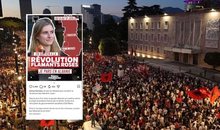
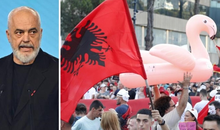
French MEP joins protests in Albania: Support for the "Pink Flamingo Revolution"
2026-07-09 19:28:07

Has the lek strengthened or overvalued?
2026-07-09 17:58:05
The trial on the merits for Ilir Meta and Monika Kryemadhi is postponed
2026-07-09 16:47:58

The match between England and Norway risks being postponed, this is the reason
2026-07-09 16:12:46
Murder in Shkodra/ Relatives: Peaceful family, no problems
2026-07-09 16:10:02
Kurti invites opposition leaders to a meeting to create new institutions
2026-07-09 15:43:05

This is the 62-year-old man who killed his wife in Shkodra
2026-07-09 15:01:43

Domestic crime/ Wife killed with shotgun, perpetrator and victim identified
2026-07-09 14:05:18
Gunfire in Shkodra, one victim suspected
2026-07-09 13:49:41
Weapons cache discovered in Fier, Prosecution sends 38-year-old to trial
2026-07-09 13:35:48
Bota e muzikës në zi, ndahet nga jeta në moshën 75-vjeçare ikona Bonnie Tyler
2026-07-09 12:56:29
Monika Kryemadhi in the Criminal Court: The cell phone was seized illegally
2026-07-09 12:45:54
VALEN MP reacts after border detention: Albania is no one's property
2026-07-09 12:15:44
Albanian gang in Belgium sentenced for trafficking 7 tons of cocaine
2026-07-09 12:01:14
Justin Bieber, Shakira and Madonna to perform at 2026 World Cup final
2026-07-09 11:52:54
Euro falls, inflation rises and domestic production loses ground
2026-07-09 11:39:36
Trial at the GJKKO, Meta's new lawyer appears in the session
2026-07-09 11:29:47
Nighttime accident in Gramsh, man and woman injured
2026-07-09 11:20:25
Meta seeks 134 witnesses, GJKKO delivers decision today
2026-07-09 10:56:54

At the peak of the production season, vegetable prices 'fly'
2026-07-09 10:21:14
The African heat returns, the thermometer reaches 40 degrees this weekend
2026-07-09 10:08:08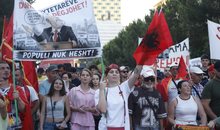
Opinions from 'anonymous' authors target Flamingo protests
2026-07-09 10:07:15
MEP Waitz: The law on protected areas endangers Albania's path to the EU
2026-07-09 09:52:55
"Le Courrier des Balkans": Edi Rama and the megalomania of power
2026-07-09 09:40:26
The economics of concerts, the prime minister's imaginary 100 million euros
2026-07-09 09:28:19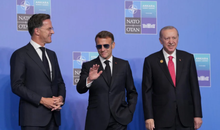
Erdogan's strange gift to NATO leaders
2026-07-09 09:11:15
Foreign exchange, the rate at which foreign currencies are sold and bought
2026-07-09 08:30:41
“Uniteti i jashtëzakonshëm” i NATO-s dhe mesazhet kryesore nga samiti në Turqi
2026-07-09 08:11:17

Horoskopi, njihuni me parashikim e yjeve
2026-07-09 07:46:15
Alternime kthjellimesh e vranësirash, parashikimi i motit
2026-07-09 07:25:59
Posta e mëngjesit/ Me 2 rreshta: Çfarë pati rëndësi dje në Shqipëri
2026-07-09 07:02:12




Rama brings West in Tirana, using Eastern premises
2026-07-08 20:41:42


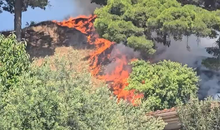
Fire on Kuzum Baba hill in Vlora, flames endanger homes and Tekke
2026-07-08 18:09:45

Shqipëria po plaket, qeveria pa plan
2026-07-08 15:57:26