 Flash News
VIDEO-scandal in Saranda/ Director of AMP Vlora and officials sexually harass tourists
"The New York Times" about Ye's concert: How Rama justifies the $4.5 million in funding
The suspected perpetrator of the murder in Laç is identified, he shot the 40-year-old 7 times near the palace
7 bullets on the doorstep, who is the 40-year-old with 4 surnames who was killed in Laç
Morning Post/ In 2 lines: What mattered yesterday in Albania

Gentian Gaba
The easiest way to relativize Edi Rama’s act of obstructing justice in Parliament — by voting against it and becoming an obstacle for SPAK in the Balluku case — is to encourage a broad societal debate about corruption. Meanwhile, the decision that blocked integration, taken with 83 raised cards, has a clear name and a clear responsibility. This is not a debate that can be reduced to sociological analysis or narratives about a country’s “culture.” It is a moment that demands political and institutional action to address a concrete violation.
In fact, the European Union itself settled this debate at its very origin with the adoption of the Copenhagen criteria — the fundamental standards every country must meet to join the EU. Albania committed to these standards when it signed the Stabilization and Association Agreement, when it became a candidate country, and when it opened accession negotiations — despite the delays and missteps caused by the problems of Rama’s government.
By embarking on this path, Albania — where internal consensus on EU integration has, for decades, exceeded the expectations of successive technocrats, including those holding positions like Ms. Kos today — has undertaken a slow but persistent reform process to meet the requirements of Brussels and the member states. This process represents a second phase of state-building, whose cornerstone is the Justice Reform.
Requested, supported, and co-financed by the EU, this reform has produced results that, despite its flaws and delays, remain the only “boxes” consistently marked positively in European Commission reports. Albania has made the necessary progress to glimpse light at the end of the integration tunnel.
Although national and international attention has focused primarily on SPAK and GJKKO — leaving in the shadows the broader dysfunctions of the general judiciary that affect hundreds of thousands of citizens — the reform has served as a solution to the Gordian knot of Albania’s transition: impunity and high-level corruption.
This was, in essence, a process of international political engineering aimed at addressing the Achilles’ heel of the past three decades. It sought to make Albania integrable and compliant with Chapters 23 and 24 of the accession process by targeting corruption at its source — the highest levels of state power. As in tango, corruption requires two actors: the one who pays for favors and the one who exercises public authority.
With the establishment and consolidation of these institutions, and with the revitalization of the justice system — a sine qua non condition for any functional democracy alongside the executive and legislative branches — the country was meant to stand on its own feet, confronting problems head-on rather than evading them.
The proper functioning of this virtuous circle — a justice system capable of balancing power and acting as both a preventive and punitive force against high-ranking officials — would have halted the vicious cycle that has drained energy, resources, and human capital, driving a significant portion of the population to emigrate.
In this process, Albanians — whose “mindset” has been criticized by Ms. Kos — have overwhelmingly supported justice, particularly SPAK and GJKKO, precisely because they sought an end to impunity and a frontal fight against corruption, not its preservation. Unlike Ms. Kos’s implication, Albanians have trusted the promise of the EU and the United States that justice reform was in the interest of their society.
Therefore, this debate about the “mindset” of our people, in a society that supports justice and EU integration through reforms aimed at positive transformation, is either naïve or a deliberate attempt to relativize the stance of Edi Rama and his parliamentary majority against SPAK’s request to lift the immunity of Deputy Prime Minister Belinda Balluku.
This was a conscious political act. Rama and his parliamentary majority acted in full awareness, in defiance of warnings from Brussels and European political centers, which had informed him in advance of the consequences for Albania’s accession process. The stagnation of the Interim Benchmark Assessment Report (IBAR), which was not approved by the Council of the European Union following Rama’s frontal attack on justice, was not an expression of Albanian society’s will. It was the expression of Edi Rama’s political will — choosing personal survival over negotiations with the EU.
Ms. Kos’s misunderstanding, whether intentional or not, cannot shift either the debate or the blame from the government onto the people. That would amount to collective punishment for the decisions of a single individual who has controlled the country since 2013 — steering the state like a cunning autocrat who behaves abroad as a liberal artist, while at home using democracy as a vehicle for consolidating power.
Now that he has reached his destination — an authoritarian, corrupt, and clientelist system — he chose to step off only when asked to relinquish his closest associate, Belinda Balluku, who has effectively functioned as his political extension in public office.
What Albanians expect from Ms. Kos is to call things by their name, as her superiors — EU member states — have already done by effectively “failing” Edi Rama when he became an obstacle to justice. Not to justify the actions of a single politician who has ruled with an iron grip for 13 years, turning Albania into an electoral autocracy where the playing field is unequal and the line between state and ruling party has effectively disappeared.
Much has changed in Albania over these 13 years. But Edi Rama has remained the constant — in a country where criminals enter parliament, organized crime penetrates the police, fields across the country are planted with cannabis, EU agricultural funds are misused, EU waste-management strategies are burned to make way for corrupt incinerator schemes that do not exist, European roads fill with Albanian asylum seekers, cybersecurity funds are managed by networks under investigation by SPAK, and functional democracy — a core requirement of the Copenhagen criteria — has been suffocated.
All of this has allowed Rama to renew his mandate without political accountability, presenting formal electoral exercises as a form of amnesty for political wrongdoing. And now that SPAK has reached the threshold of his office, he uses the force of parliamentary votes to deny Albanians the opportunity to internalize a fundamental Western principle: equality before the law.
The obstruction of justice has a name.
Everything else is an alibi — one that risks eroding Albanians’ trust not only in their own institutions, but also in the European Union and in the commitments funded by European taxpayers in Albania.
Latest news

Heatwave hits Germany, over 5,400 heat-related deaths
2026-07-10 10:45:33
Land in "foreign hands"
2026-07-10 10:26:15
Mbappe the hero of France, the "Roosters" knock out Morocco in the quarterfinals
2026-07-10 09:54:33
Durrës/ 40-year-old man stabs his wife
2026-07-10 09:48:03


How much could the amount of drug money in the Albanian economy be?!
2026-07-10 09:08:34
Government reduces funds for farmers, increases ADF by 75 million euros
2026-07-10 08:55:46
Horoscope, get to know the star forecast
2026-07-10 08:32:54

Morning Post/ In 2 lines: What mattered yesterday in Albania
2026-07-10 07:52:04
A person was shot dead in Kurbin, first details
2026-07-09 22:54:48

Will the Police also stop those who criticize Rama online?
2026-07-09 21:57:02


FIFA decision shocks England, Quansah ruled out for two matches
2026-07-09 20:51:00
Protest/Pedagogue: 4 million euros for Kanye West is "the next concession"
2026-07-09 19:45:53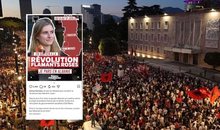
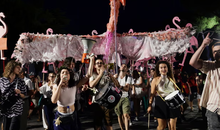
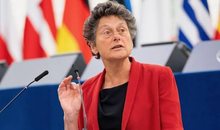
French MEP joins protests in Albania: Support for the "Pink Flamingo Revolution"
2026-07-09 19:28:07

Has the lek strengthened or overvalued?
2026-07-09 17:58:05
The trial on the merits for Ilir Meta and Monika Kryemadhi is postponed
2026-07-09 16:47:58

The match between England and Norway risks being postponed, this is the reason
2026-07-09 16:12:46
Murder in Shkodra/ Relatives: Peaceful family, no problems
2026-07-09 16:10:02
Kurti invites opposition leaders to a meeting to create new institutions
2026-07-09 15:43:05

This is the 62-year-old man who killed his wife in Shkodra
2026-07-09 15:01:43

Domestic crime/ Wife killed with shotgun, perpetrator and victim identified
2026-07-09 14:05:18
Gunfire in Shkodra, one victim suspected
2026-07-09 13:49:41
Weapons cache discovered in Fier, Prosecution sends 38-year-old to trial
2026-07-09 13:35:48

Bota e muzikës në zi, ndahet nga jeta në moshën 75-vjeçare ikona Bonnie Tyler
2026-07-09 12:56:29
Monika Kryemadhi in the Criminal Court: The cell phone was seized illegally
2026-07-09 12:45:54
VALEN MP reacts after border detention: Albania is no one's property
2026-07-09 12:15:44
Albanian gang in Belgium sentenced for trafficking 7 tons of cocaine
2026-07-09 12:01:14
Justin Bieber, Shakira and Madonna to perform at 2026 World Cup final
2026-07-09 11:52:54
Euro falls, inflation rises and domestic production loses ground
2026-07-09 11:39:36
Trial at the GJKKO, Meta's new lawyer appears in the session
2026-07-09 11:29:47
Nighttime accident in Gramsh, man and woman injured
2026-07-09 11:20:25
Meta seeks 134 witnesses, GJKKO delivers decision today
2026-07-09 10:56:54

At the peak of the production season, vegetable prices 'fly'
2026-07-09 10:21:14
The African heat returns, the thermometer reaches 40 degrees this weekend
2026-07-09 10:08:08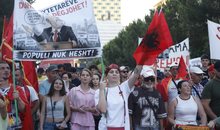
Opinions from 'anonymous' authors target Flamingo protests
2026-07-09 10:07:15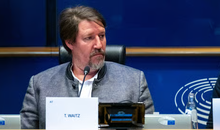
MEP Waitz: The law on protected areas endangers Albania's path to the EU
2026-07-09 09:52:55
"Le Courrier des Balkans": Edi Rama and the megalomania of power
2026-07-09 09:40:26
The economics of concerts, the prime minister's imaginary 100 million euros
2026-07-09 09:28:19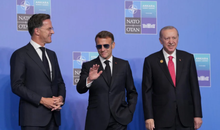
Erdogan's strange gift to NATO leaders
2026-07-09 09:11:15
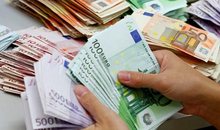
Foreign exchange, the rate at which foreign currencies are sold and bought
2026-07-09 08:30:41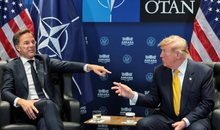
“Uniteti i jashtëzakonshëm” i NATO-s dhe mesazhet kryesore nga samiti në Turqi
2026-07-09 08:11:17
Horoskopi, njihuni me parashikim e yjeve
2026-07-09 07:46:15
Alternime kthjellimesh e vranësirash, parashikimi i motit
2026-07-09 07:25:59
Posta e mëngjesit/ Me 2 rreshta: Çfarë pati rëndësi dje në Shqipëri
2026-07-09 07:02:12



Rama brings West in Tirana, using Eastern premises
2026-07-08 20:41:42
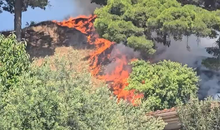
Fire on Kuzum Baba hill in Vlora, flames endanger homes and Tekke
2026-07-08 18:09:45

Shqipëria po plaket, qeveria pa plan
2026-07-08 15:57:26