 Flash News
VIDEO-scandal in Saranda/ Director of AMP Vlora and officials sexually harass tourists
"The New York Times" about Ye's concert: How Rama justifies the $4.5 million in funding
The suspected perpetrator of the murder in Laç is identified, he shot the 40-year-old 7 times near the palace
7 bullets on the doorstep, who is the 40-year-old with 4 surnames who was killed in Laç
Morning Post/ In 2 lines: What mattered yesterday in Albania
Alfred Lela
The race for Tirana’s municipality is not, in fact, about governing the city, nor is it a competition to demonstrate who has the better alternative in this branch of local power, the largest in the country.
It is a race to dismantle Edi Rama, as it is a challenge directed against him, against his overreach of power, his autocratic dictatorship, and his insatiable lust as a political creature to control every corner of authority in the country.
Whoever sees this as a race about street cleaning, traffic, café chairs on sidewalks, or five other trivialities, does nothing but allow Edi Rama to extend both his grip and his philosophy further over the capital and Albania.
It is, therefore, a battle of political and urban philosophy: of polity more than policy, of political design more than urban design.
Having said this, without wishing to offend anyone, it is not a battle about any of the names put forward so far.
Because all the candidates who have expressed their desire, their self-sacrifice, or even those who have withdrawn, would not in reality be facing Ogerta Manastirliu, but Edi Rama himself.
In this sense, the Democratic Party needs to return to where it once was. In 2003, when—against Rama himself—it nominated Spartak Ngjela, then one of Berisha’s associates but not a “loyalist,” and one of the eloquent voices of the opposition. Not necessarily Ngjela himself, of course, but someone with a similar public profile—one who fights Rama through Rama, from the recesses of his consciousness and subconscious, of his past and his present.
That profile, better than anyone else, is fulfilled by Fatos Lubonja.
Lubonja, of course, is more than that. In the “Flattened Society” that Edi Rama has fought so hard to construct in Albania, Lubonja is one of the very few remaining reliefs.
He carries in his life curriculum prison, resistance, and survival against dictatorship. He fought Berisha and the right in 1997, and he has spent nearly two decades battling the authoritarian archetype of Edi Rama, once his friend.
In this sense, he is a candidate of transversal resistance and of the horizontal city. And the Democratic Party, if it wishes to be honest with itself, has no comparable figure in its ranks.
Lubonja’s candidacy is not a confrontation with Manastirliu; it is the counter-candidacy to Rama. Lubonja can defeat Rama because he can show the public—through the depth and authenticity of the contrast—who Edi Rama really is.
Others would be swallowed by the vacuum of baseness created by Rama himself and his propaganda machine: “We are not the best, but there are no better than us,” or “We are all the same, but at least I am entertaining.”
With Lubonja, the Democratic Party steps outside its own ranks but enters the city. I am fully aware of the hundreds of pursed lips of dissatisfied Democrats, but the political context is such that the paradigm cannot be anything other than this: if the DP cannot win, the second-best outcome is that someone defeats Edi Rama.
As for public communication, which is also the concern of the undersigned, Lubonja does not need packaging, branding, or coaching. He is a trusted public voice, one that resonates with the left, with the gray zone, and with Democrats—with whom, for more than a decade, he has shared the anti-Rama battle.
Given the fatal brevity of time for this confrontation, this point is of immense value.
Lubonja is the right candidate, especially since the state of the government and the Socialist Party in Tirana—after Veliaj’s imprisonment, after the “5D” scandal, after the incinerator affairs—is exactly what he has been describing for years. His old theory of “two gangs,” meaning the two big parties, has collapsed, because now there is only one gang. As a citizen and as an intellectual, it is both his duty and his honor to stand against the Uni-Gang in power.
Even if he does not win the municipality, the contrast he would create would provide the most accurate portrait of Edi Rama, and a telegram announcing the end of his rule.
What is needed, then, is not an “Ogert” or an “Ogerta” to face Rama’s Ogerta—but an anti-Rama: someone who makes the duel appear equal, and winnable.
The opposition, in Tirana, needs a duel—not a group skirmish.
Latest news
Heatwave hits Germany, over 5,400 heat-related deaths
2026-07-10 10:45:33
Land in "foreign hands"
2026-07-10 10:26:15
Mbappe the hero of France, the "Roosters" knock out Morocco in the quarterfinals
2026-07-10 09:54:33
Durrës/ 40-year-old man stabs his wife
2026-07-10 09:48:03


How much could the amount of drug money in the Albanian economy be?!
2026-07-10 09:08:34
Government reduces funds for farmers, increases ADF by 75 million euros
2026-07-10 08:55:46
Horoscope, get to know the star forecast
2026-07-10 08:32:54

Morning Post/ In 2 lines: What mattered yesterday in Albania
2026-07-10 07:52:04
A person was shot dead in Kurbin, first details
2026-07-09 22:54:48

Will the Police also stop those who criticize Rama online?
2026-07-09 21:57:02


FIFA decision shocks England, Quansah ruled out for two matches
2026-07-09 20:51:00
Protest/Pedagogue: 4 million euros for Kanye West is "the next concession"
2026-07-09 19:45:53
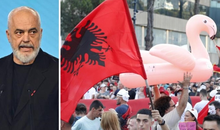
French MEP joins protests in Albania: Support for the "Pink Flamingo Revolution"
2026-07-09 19:28:07

Has the lek strengthened or overvalued?
2026-07-09 17:58:05

The trial on the merits for Ilir Meta and Monika Kryemadhi is postponed
2026-07-09 16:47:58

The match between England and Norway risks being postponed, this is the reason
2026-07-09 16:12:46
Murder in Shkodra/ Relatives: Peaceful family, no problems
2026-07-09 16:10:02
Kurti invites opposition leaders to a meeting to create new institutions
2026-07-09 15:43:05
This is the 62-year-old man who killed his wife in Shkodra
2026-07-09 15:01:43

Domestic crime/ Wife killed with shotgun, perpetrator and victim identified
2026-07-09 14:05:18
Gunfire in Shkodra, one victim suspected
2026-07-09 13:49:41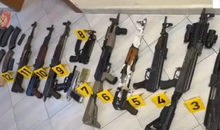
Weapons cache discovered in Fier, Prosecution sends 38-year-old to trial
2026-07-09 13:35:48
Bota e muzikës në zi, ndahet nga jeta në moshën 75-vjeçare ikona Bonnie Tyler
2026-07-09 12:56:29
Monika Kryemadhi in the Criminal Court: The cell phone was seized illegally
2026-07-09 12:45:54
VALEN MP reacts after border detention: Albania is no one's property
2026-07-09 12:15:44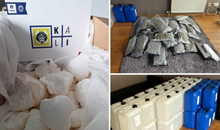
Albanian gang in Belgium sentenced for trafficking 7 tons of cocaine
2026-07-09 12:01:14
Justin Bieber, Shakira and Madonna to perform at 2026 World Cup final
2026-07-09 11:52:54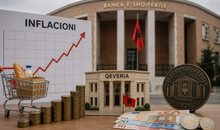
Euro falls, inflation rises and domestic production loses ground
2026-07-09 11:39:36
Trial at the GJKKO, Meta's new lawyer appears in the session
2026-07-09 11:29:47
Nighttime accident in Gramsh, man and woman injured
2026-07-09 11:20:25
Meta seeks 134 witnesses, GJKKO delivers decision today
2026-07-09 10:56:54
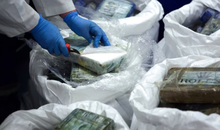

At the peak of the production season, vegetable prices 'fly'
2026-07-09 10:21:14
The African heat returns, the thermometer reaches 40 degrees this weekend
2026-07-09 10:08:08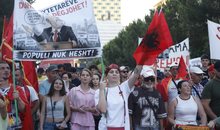
Opinions from 'anonymous' authors target Flamingo protests
2026-07-09 10:07:15
MEP Waitz: The law on protected areas endangers Albania's path to the EU
2026-07-09 09:52:55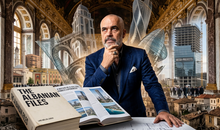
"Le Courrier des Balkans": Edi Rama and the megalomania of power
2026-07-09 09:40:26
The economics of concerts, the prime minister's imaginary 100 million euros
2026-07-09 09:28:19
Erdogan's strange gift to NATO leaders
2026-07-09 09:11:15
Foreign exchange, the rate at which foreign currencies are sold and bought
2026-07-09 08:30:41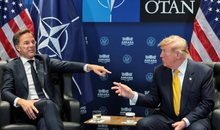
“Uniteti i jashtëzakonshëm” i NATO-s dhe mesazhet kryesore nga samiti në Turqi
2026-07-09 08:11:17
Horoskopi, njihuni me parashikim e yjeve
2026-07-09 07:46:15
Alternime kthjellimesh e vranësirash, parashikimi i motit
2026-07-09 07:25:59
Posta e mëngjesit/ Me 2 rreshta: Çfarë pati rëndësi dje në Shqipëri
2026-07-09 07:02:12


Rama brings West in Tirana, using Eastern premises
2026-07-08 20:41:42


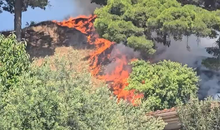
Fire on Kuzum Baba hill in Vlora, flames endanger homes and Tekke
2026-07-08 18:09:45

Shqipëria po plaket, qeveria pa plan
2026-07-08 15:57:26