
 Flash News
VIDEO-scandal in Saranda/ Director of AMP Vlora and officials sexually harass tourists
"The New York Times" about Ye's concert: How Rama justifies the $4.5 million in funding
The suspected perpetrator of the murder in Laç is identified, he shot the 40-year-old 7 times near the palace
7 bullets on the doorstep, who is the 40-year-old with 4 surnames who was killed in Laç
Morning Post/ In 2 lines: What mattered yesterday in Albania

Akil Pano
The history of civilizations does not begin with great catastrophes. It begins with silence. It begins with a moment when wise people fall silent.
When the elites do not speak. When the crowd adapts.
One of the most symbolic moments of this phenomenon occurred in ancient Rome. The event invites us to see the court of Emperor Nero, who in history is known as the most savage persecutor of Christians. The Roman historians Tacitus and Suetonius tell an unusual episode. The Roman Emperor Nero had lost his wife, Poppaea Sabina. One day, a young boy who resembled her appeared in the emperor's court.
The boy was named Sporus.
When Nero saw him, he ordered the boy to be castrated. Then he dressed him in the clothes of the empress and organized a public wedding ceremony.
Sporus was introduced as the emperor's wife.
But what is most shocking in this story is not the action of a tyrant! It is the reaction of society. The Roman Senate did not protest. Philosophers and elites were silent.
Here, history teaches us a frightening truth:
Society can be taught any absurdity if the power demands it.
Plato warned about this process in his work The Republic! He wrote that democracies can degrade when people begin to lose the difference between right and wrong. At this moment, tyranny arises.
Not because the tyrant is strong. But society has become morally corrupt.
Aristotle, in his work The Politics, writes something important.
“Tyranny does not rely on force alone. It relies on the corruption of the elites.” When political, economic, and intellectual elites begin to defend power instead of controlling it, institutions become a facade. And the state begins to rot from within.
In the 20th century, philosopher Hannah Arendt analyzed this phenomenon. She called it “The banality of evil.”
Evil does not triumph just because there are bad people. It triumphs because normal people adapt to the system.
Because they say: “It’s none of my business, I don’t want trouble, everyone is doing the same thing.”
Thus, tyrannies are not only built by dictators. Tyrannies are built by the silence, fear, indifference, and conformity of society.
George Orwell described this process in the novel 1984. He warned that modern power does not rule through force alone. It rules through the manipulation of reality.
When people begin to believe that black is white, weakness is strength, and lies are truth, then society enters a dangerous era.
The historian Edward Gibbon wrote in his famous work on the fall of Rome that civilizations do not collapse only because of enemies. They collapse when institutions become corrupt, the law loses its authority, and public trust disappears.
Rome did not fall in a day. It fell gradually.
Today, Albanian society faces the same dangers. When citizens see corruption scandals, abuse of power, and capture of institutions, public trust begins to disintegrate. This is the challenge for Albania today. Albania, like many other countries in transition, faces constant criticism for high-level corruption,
problems with the rule of law,
and the weakness of institutions.
In this context, an important question arises:
Will citizens and institutions react to strengthen democracy? Or will they adapt further and deeper to the system?
The story of Nero and Sporus is a metaphor for the process of deep decadence of a society that does not react.
When a society stops telling the truth, the absurd becomes normal. When elites are silent, power becomes arrogant. When citizens surrender, institutions weaken. History is a mirror for the present. The question is very simple:
Do we have the courage to defend the truth? Do we have the courage to defend institutions? Do we have the courage to say “no” when power demands silence?
The story of Nero and Sporus is not a strange story from ancient Rome. It is a warning. Civilizations are not destroyed by barbarians outside the walls.
They are often destroyed by corruption and silence within them.
And in the end, history asks every generation the same question:
When the crowd says, “Shut up, it’s none of your business, don’t bother… will you have the courage to stand up for the truth?”
Latest news



Heatwave hits Germany, over 5,400 heat-related deaths
2026-07-10 10:45:33

Land in "foreign hands"
2026-07-10 10:26:15

Mbappe the hero of France, the "Roosters" knock out Morocco in the quarterfinals
2026-07-10 09:54:33
Durrës/ 40-year-old man stabs his wife
2026-07-10 09:48:03


How much could the amount of drug money in the Albanian economy be?!
2026-07-10 09:08:34
Government reduces funds for farmers, increases ADF by 75 million euros
2026-07-10 08:55:46
Horoscope, get to know the star forecast
2026-07-10 08:32:54


Morning Post/ In 2 lines: What mattered yesterday in Albania
2026-07-10 07:52:04
A person was shot dead in Kurbin, first details
2026-07-09 22:54:48


Will the Police also stop those who criticize Rama online?
2026-07-09 21:57:02


FIFA decision shocks England, Quansah ruled out for two matches
2026-07-09 20:51:00


Protest/Pedagogue: 4 million euros for Kanye West is "the next concession"
2026-07-09 19:45:53
French MEP joins protests in Albania: Support for the "Pink Flamingo Revolution"
2026-07-09 19:28:07



Has the lek strengthened or overvalued?
2026-07-09 17:58:05




The trial on the merits for Ilir Meta and Monika Kryemadhi is postponed
2026-07-09 16:47:58

The match between England and Norway risks being postponed, this is the reason
2026-07-09 16:12:46
Murder in Shkodra/ Relatives: Peaceful family, no problems
2026-07-09 16:10:02
Kurti invites opposition leaders to a meeting to create new institutions
2026-07-09 15:43:05

This is the 62-year-old man who killed his wife in Shkodra
2026-07-09 15:01:43

Domestic crime/ Wife killed with shotgun, perpetrator and victim identified
2026-07-09 14:05:18
Gunfire in Shkodra, one victim suspected
2026-07-09 13:49:41
Weapons cache discovered in Fier, Prosecution sends 38-year-old to trial
2026-07-09 13:35:48

Bota e muzikës në zi, ndahet nga jeta në moshën 75-vjeçare ikona Bonnie Tyler
2026-07-09 12:56:29
Monika Kryemadhi in the Criminal Court: The cell phone was seized illegally
2026-07-09 12:45:54


VALEN MP reacts after border detention: Albania is no one's property
2026-07-09 12:15:44
Albanian gang in Belgium sentenced for trafficking 7 tons of cocaine
2026-07-09 12:01:14
Justin Bieber, Shakira and Madonna to perform at 2026 World Cup final
2026-07-09 11:52:54
Euro falls, inflation rises and domestic production loses ground
2026-07-09 11:39:36
Trial at the GJKKO, Meta's new lawyer appears in the session
2026-07-09 11:29:47
Nighttime accident in Gramsh, man and woman injured
2026-07-09 11:20:25


Meta seeks 134 witnesses, GJKKO delivers decision today
2026-07-09 10:56:54



At the peak of the production season, vegetable prices 'fly'
2026-07-09 10:21:14
The African heat returns, the thermometer reaches 40 degrees this weekend
2026-07-09 10:08:08
Opinions from 'anonymous' authors target Flamingo protests
2026-07-09 10:07:15
MEP Waitz: The law on protected areas endangers Albania's path to the EU
2026-07-09 09:52:55
"Le Courrier des Balkans": Edi Rama and the megalomania of power
2026-07-09 09:40:26
The economics of concerts, the prime minister's imaginary 100 million euros
2026-07-09 09:28:19
Erdogan's strange gift to NATO leaders
2026-07-09 09:11:15


Foreign exchange, the rate at which foreign currencies are sold and bought
2026-07-09 08:30:41
“Uniteti i jashtëzakonshëm” i NATO-s dhe mesazhet kryesore nga samiti në Turqi
2026-07-09 08:11:17

Horoskopi, njihuni me parashikim e yjeve
2026-07-09 07:46:15
Alternime kthjellimesh e vranësirash, parashikimi i motit
2026-07-09 07:25:59
Posta e mëngjesit/ Me 2 rreshta: Çfarë pati rëndësi dje në Shqipëri
2026-07-09 07:02:12






Rama brings West in Tirana, using Eastern premises
2026-07-08 20:41:42


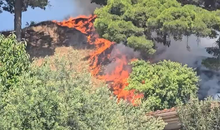
Fire on Kuzum Baba hill in Vlora, flames endanger homes and Tekke
2026-07-08 18:09:45




Shqipëria po plaket, qeveria pa plan
2026-07-08 15:57:26