Flash News
Berisha at the National Council: The DP, an undefeated party, internationalized denunciations of the narco-state
The DP National Council meets, Berisha presents the proposed names for the members of the Diaspora Council
The "Face of Instagram" and the Plastic Surgery Nightmare
PD mbledh sot Këshillin Kombëtar, në rend dite zgjedhja e strukturave të reja drejtuese
28-year-old Albanian man murdered in Britain, police identify victim
The "Face of Instagram" and the Plastic Surgery Nightmare
Instagram-i kërkoi një lloj të caktuar gruaje dhe më pas e prodhoi atë, duke çoroditur në këtë proces segmente të tëra të shoqërisë. Inteligjenca artificiale, e cila ofron një përvojë të plasticitetit absolut dhe ndërtohet mbi premisën se gjithçka që është njerëzore është inferiore pikërisht sepse është e papërsosur, do ta përkeqësojë edhe më tej këtë realitet.

Politiko
2026-07-15 18:09:09
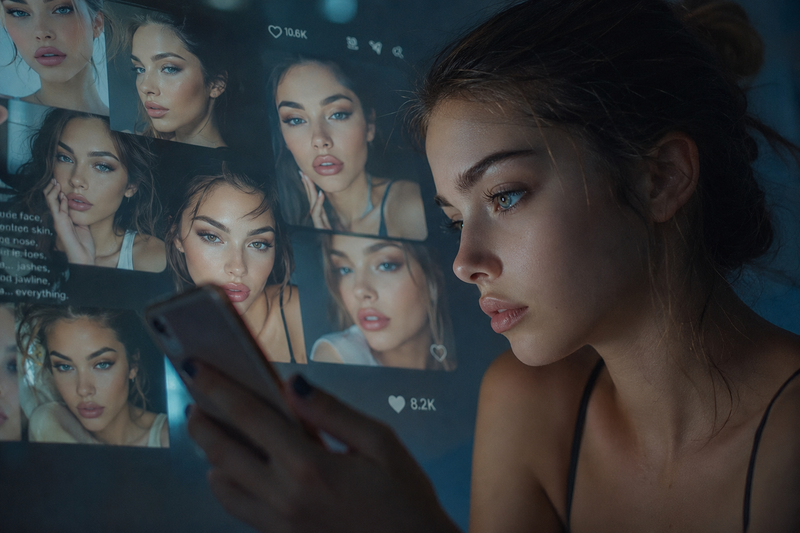
Joa Tolentino/ The New Yorker
Photo produced with ChatGPT
To borrow a phrase from Simone de Beauvoir, the face is not a thing but a situation—a situation that is, increasingly, more technically beautiful but less spiritually appealing; filled with new information but empty of human meaning. Today, young people inject their faces and look older; old people inject their faces and take on a strange, almost frightening appearance; a twenty-year-old became famous by hitting his jaw with a hammer to make himself more attractive; teenagers ask strangers online if a facelift is their only hope.
The Internet, with astonishing ease, subverts the very basic notions of human identity, recasting people as commodities and fragmenting us into discrete parts. Only recently, however, has this process been imprinted so directly on the face, traditionally considered the gateway to our humanity. The face is being separated from the person, and the person is being separated from the soul. And it is happening before our eyes, on our phones, in the most banal way possible, every day.
About a decade ago, the most visible faces on Instagram—those of famous, mostly white, models and influencers—began to resemble one another. They already had full lips, cat-like eyes, high cheekbones, and flawless skin; Botox and fillers made their lips even plumper, their eyes even more “cat-like,” their cheekbones even more pronounced. They began to look like cyborgs, with faces modeled by algorithms and constantly glowing in the light of digital approval. Beauty, especially for women, has long been a form of capital, and smartphones perfectly codified this logic: they gave users digital tools to look more beautiful in photos and videos, as well as monetized platforms to share these edited faces, which could then be adjusted in the real world through cosmetic procedures to match their virtual counterparts. This cycle of digital and physical optimization created a new ideal and new habits. The tip of an aesthetic syringe needle is roughly a quarter of a millimeter: the Overton window on what is acceptable to do to the face has expanded through almost imperceptible changes.
Today, we’ve reached a point where you can buy an “Instagram Face” at your local cosmetic clinic, while the wealthiest people are seeking out facelifts. The “Instagram Face” can be achieved with minor adjustments and outpatient procedures, though the results are often patently artificial: When Kylie Jenner first started using fillers as a teenager, it was clear that her lips had been injected. In contrast, the refined results of the new facelifts hide much more invasive interventions—hours of incisions and manipulation of fascia, muscle, and fat. A New York magazine writer closely observed a deep-plane facelift and described the moment the surgeon’s fingers slid down the patient’s cheek: “Once all the necessary ligaments are cut, the facial features move freely and as one, like a Halloween mask.”
This surgical violence produces an almost superhuman result. Lindsay Lohan, a millennial icon, returned to 2025 after a period of relative obscurity with the skin of a toddler and the forehead of a man who had never known worry—a face identical to hers, but as if it had been created by blushing angels at dawn that very day. (Lohan has stated that her appearance is the result of Botox and a healthy lifestyle.) Kris Jenner, at seventy, after her second facelift, looked stunning—at least as young as her daughters in their forties, who have become famous precisely for their public transformations of their bodies and faces. People magazine described a package of nine procedures—deep-plane facelift, deep neck lift, forehead lift, upper lip lift, earlobe reduction, and other procedures—performed in a single six-hour session on a 65-year-old woman, who then looked like a fifty-year-old teenager: a stage of life that had until then existed only in the imagination.
Once, plastic surgery seemed commonplace and vulgar; its visible signs were the very price people paid for refusing to age. This straightforward artificiality has not entirely disappeared. It is still present, for example, in what is called “Mar-a-Lago Face,” an exaggerated look often found on women in the second Trump administration, accompanied by a makeup style that expresses a lack of interest in naturalness. (Like the administration itself, “Mar-a-Lago Face” finds its power in the spectacle of denying reality.) But today’s most expensive plastic surgery is almost invisible, unbroken in appearance, with a somewhat gnostic character, as if it were the fruit of a secret and intricate knowledge.
On social media, amateur analysts endlessly speculate about the cosmetic procedures that celebrities may have undergone. Sometimes the celebrities themselves respond to these discussions. Kylie Jenner, for example, commented under a TikTok video dedicated to her breast implants: "445 cc, medium profile, half under muscle!!!!! silicone!!!". Vogue magazine called 2025 "the year of plastic surgery transparency".
At first glance, this candor seems commendable. But when celebrities open up about plastic surgery, it often feels like a ceremonial declaration made before continuing with the same practice that has just been acknowledged as problematic. Vogue quoted one plastic surgeon as saying that this openness helps "to soften unrealistic beauty standards that cause self-esteem issues in young women," as well as making "plastic surgery feel more human and accessible."
In other words, if celebrities admit to having plastic surgery, then the rest of society will also get more plastic surgery — and this is presented as a positive thing, because our self-esteem has been damaged precisely by the fact that so many celebrities have had plastic surgery.
For now, pre-retirement facelifts remain a habit restricted to the extremely wealthy and the extremely vain. Yet this very group is overrepresented in our visual culture. They are faces created to be profitably displayed, primarily on screens, and for this reason the desire to change the face spreads rapidly.
A recent survey by the American Academy of Facial Plastic and Reconstructive Surgery predicts a 19 percent increase in facial cosmetic procedures. The authors point out that “one of the most significant changes observed in this year’s survey is not related to the procedures patients choose, but to the age at which they decide to have them performed.” Fifty-seven percent of surgeons reported an increase in the number of patients under the age of thirty seeking cosmetic procedures. In 2024 alone, the American Society of Plastic Surgeons recorded nearly 50,000 Botox and filler procedures on patients under the age of twenty.
If you Google the phrase "facelift in your thirties," the first suggested results might tell you that "a mini-facelift is ideal" for this age group and that "a mini-facelift at age 35 can be a thoughtful and fulfilling choice." The AI-generated summary at the top of the results informed me that surgical facelifts are still uncommon for people in their thirties and that early signs of aging are "typically treated" with injections and laser skin resurfacing.
The space for visible debate has become extremely narrow. It is not difficult to understand why so many young people, who live in constant dialogue with what they see on their phones, have moved from the idea of "preventive" Botox to the belief that any visible sign of aging, at any age, should be treated as if it were a disease.
Even in this respect, men still have it easier than women. A key reason is that men are often perceived as more attractive as they age. However, male beauty standards have risen significantly over the past decade.
In the age of social media, women have managed to impose new norms on men, both morally and aesthetically. On the one hand, men should no longer engage in sexual harassment in the workplace; on the other, it would be nice if they were also expected to be extremely physically attractive. Women have gained the confidence and public platforms to talk about men in the same way that men have traditionally talked about women — often with disdain.
For generations, women have been taught from a young age how to avoid disgust and disrespect from men. Girls understand as early as elementary school that they should be sweet, smiling, and adaptable; ideally, they should also be ladylike, interesting, and, of course, beautiful.
Many men, exposed for the first time to heterosexual scorn as a culturally influential force, have proven far less prepared to deal with it within the confines of a normal social contract. For them, it has been shocking: social media posts, products with ironic slogans (T-shirts and mugs with inscriptions like: "Oh God, give me the confidence of an average white man") and, above all, dating apps, which have given some women the opportunity to treat men as consumer goods.
Men are now analyzed by women in the same way that women have long been analyzed by men: piece by piece, inch by inch. And some of them have responded by taking the female obsession with appearance, now rooted in misogyny, and reframing it in the most toxic way possible. In other words, by becoming looksmaxxers.
Looksmaxxing is a product of the men's rights movement, whose supporters once gathered in remote corners of the internet, where they built a reactionary community around the belief that women don't deserve equal rights. Today, much of that thinking has infiltrated nu-conservatism, while the rest of the public has been forced to learn who Braden Peters, better known as Clavicular — the king of the looksmaxxing world — is.
Peters, only twenty years old, looks like a very attractive guy from an American university fraternity. But his most striking features are not his physical appearance, but his obsession with achieving it. He has used peptides, supplements, methamphetamine, and even hammers, in an attempt to change his face and body. And, paradoxically, it does not seem to have brought him any happiness.
"I have almost no interest in my own happiness," he said recently on a podcast. "The idea of being happy seems very childish to me."
A few months later, he collapsed unconscious in a nightclub after a suspected overdose.
The table of contents on the looksmax.org forum lists almost every aspect of the male body and lifestyle that can be measured and "improved." It includes more than a dozen sections — such as the Eye Zone, Craniology, Penis, and more — further divided into even more esoteric subchapters, with titles like "The Influence of Limbic Rings on Facial Attraction" or "Failure of the Retracted Anterior Pillar of the Nose."
It goes without saying — or at least it can be understood from the very use of the term craniology — that looksmaxxers view race, sexuality, and disability from much the same perspective as early 20th-century eugenicists.
In the simpler days of my youth, as part of the millennial generation, trying to appear more attractive usually had one goal: to increase the likelihood of having fun and exciting sexual experiences. It was an imperfect goal, often clouded by alcohol, and problematic in its own way. But an interest in the body – your own body and the bodies of others – was a natural part of this game.
Today, this element seems to be disappearing. What is increasingly eroticized by young people, men and women alike, is no longer physical presence, but disembodied attention, mediated by the screen. Looksmaxxers do not seem interested in sex at all. Clavicular has stated that he is most likely sterile, as a result of high doses of testosterone injections since adolescence. Recently, he told The New York Times that it is more important to him to know that he can have sex with a woman than the sexual act itself, which, according to him, "will not bring me anything."
Overall, the atmosphere is that of an internet-invented asexuality. The alleged heterosexuality serves only as a pretext for public displays of dominance and submission, constantly psychologically oriented towards other equally "heterosexual" men. In the looksmax dictionary, women are called "foids", short for female humanoids, and are treated with the same mechanical coldness: torn to pieces, worshipped and humiliated at the same time.
One of the most popular posts on looksmax.org presents four versions of the list "The 30 Most Beautiful and Attractive Girls on the Planet (Based on Golden Ratio, Sexual Dimorphism, Attractiveness, and Side Profile)". The list features famous models with the so-called "Instagram Face". The author clarifies that only white women or women of mixed descent who "pass" as white are included.
For looksmaxxers, it's essential that these women look naturally beautiful. For this reason, the post dismissively excludes many of the Instagram girls who have significantly altered their appearance through cosmetic procedures. Thus, the community has invented a paradoxical way to admire men who work on their appearance, while hating women for doing the same thing.
Of course, no one understands better than a model – or perhaps any woman – that beauty is work and performance. These ridiculously contradictory impulses – admiration for women who organize their lives around their appearance and, at the same time, disgust with them precisely for doing so – can only arise in the absence of true intimacy, in the absence of daily contact with women as they are in their natural reality.
And it is precisely these ways of thinking that make true intimacy increasingly impossible. The physical self – the face and body that react to the presence of another – withdraws behind the smooth shell of longing and, from that hidden place, wonders if it will ever truly know itself.
Last year, a 36-year-old woman wrote to The Guardian's advice column, asking whether it was wrong to judge her peers who had facelifts, or even to judge herself, because she had begun to desire such a procedure herself.
The columnist responded with understanding: "It's a bit strange that beauty culture is convincing so many people to cut off a piece of facial skin and sew it back on tighter."
But then he added: "Am I judging? Yes. But judgment, like mimetic desire, is a human and inevitable part of life."
This extremely cautious tone shows the reserve of a woman writing in the delicate space between the somewhat ironic adoration and deeply ironic contempt that dominate the internet today.
The current media environment has become so bleak that any criticism of any phenomenon has faded significantly. About two decades ago, the feminist website Jezebel, in one of its first articles, offered $10,000 to anyone who could provide the original, unedited version of a magazine cover photo.
According to Jezebel, images of women in magazines were "essentially female fakes," thanks to all the computer manipulation - skin smoothing, contouring, and, in some cases, even replacing body parts.
A few months later, Jezebel published unretouched photos of country music singer Faith Hill, comparing them to the photo published on the cover of Redbook magazine, where her body had been artificially slimmed down, her eyes had been modified, and her usual facial wrinkles had completely disappeared.
Jezebel was followed by sites like DoubleX, Rookie, and The Hairpin, and a new wave of pop feminism began to penetrate mainstream culture. As an increasingly commercial form of feminism flourished, these outlets debated its values and limits.
"Is Kim Kardashian a feminist role model?" a Jezebel headline asked in 2013.
"The short answer is: no," the article began. "The long answer is: nooooooooooooo."
That same year, Sheryl Sandberg published the book "Lean In," which conveyed to millions of women the seductive idea that personal enrichment could, in itself, be a feminist act.
Instagram, now widely used, offered women a platform to "build their personal brand" by posting attractive photos of themselves. Body and facial modification, as well as constant online exposure, were also seen by many as expressions of feminism.
In 2016, BuzzFeed published the article: "Here's why Kim Kardashian is actually a feminist, even though she says she's not."
Three months later, Donald Trump was elected President of the United States.
The years that followed were marked by a chauvinistic backlash and the gradual disappearance of women's media. Most feminist websites were shut down, while print media began to wither. Many of the magazines that Jezebel once criticized—Redbook, InStyle, Marie Claire, Glamour, Self—either ceased publication in print or disappeared altogether.
(Today, the very idea of a website criticizing a magazine for using Photoshop seems almost nostalgic.)
They were publications with their shortcomings, but serious and stable, run by professionals who maintained an ongoing dialogue with readers on the state of women's lives.
Their place has been taken by Instagram and TikTok, where the public relations machines of celebrities and influencers can distribute the same aspirational images, but without dialogue, without content, and without any real commitment to anything other than algorithmic success.
One of the few ideas that has survived from the 2010s is the belief—elaborated through millions of Instagram captions—that deeply selfish actions can be part of a progressive journey toward self-actualization. It's an idea that many women have associated with cosmetic surgery.
"I never imagined that a neck lift would be such a transcendent and life-changing experience at the age of fifty-five," Kris Jenner wrote in her memoir, published in 2011.
She added that this surgical intervention had taught her "love, friendship, loyalty, self-control and the power of knowing how to let things go."
Last year, a former TV personality in her fifties opened up about her facelift on the Substack platform, with admirable candor. She explained that the procedure had changed her relationship with aging, making her "no longer apologetic" about her appearance.
Now, she wrote, I can "redefine for myself what it means to age with dignity."
For him, this meant empowerment, self-authorship, self-love, rebellion, autonomy, and evolution.
And, you have to admit, she looks stunning.
Kylie Jenner—who started getting lip fillers as a teenager, had her first breast augmentation at the age of nineteen, and built a billion-dollar business selling her exact look to consumers—has said she would be "heartbroken" if her daughter decided to get plastic surgery as a teenager.
However, the spread of these practices seems almost inevitable.
According to a study, in the period 2019–2022 alone there was a 75 percent increase in patients under the age of nineteen seeking Botox or similar aesthetic injections.
By undergoing the same procedures that older women use to look younger, young girls are changing the appearance of youth themselves.
It may soon become normal for children to fear aging before they have even entered adulthood.
A few years ago, a fourteen-year-old girl went viral on TikTok after sharing her anti-aging skin routine—a routine that, she said, she started at the age of twelve.
Children are growing up in a time when the ideal of beauty is increasingly held up by completely artificial women—perfectly physical beings created by artificial intelligence, placed in real-world scenarios, photographs, and video clips, to deceive the sexually thirsty and gullible, as well as to torment those suffering from self-doubt. (Recently, a series of videos went viral that purported to show candid shots of extremely attractive girls in the stands of baseball games. In fact, they were creations of artificial intelligence.)
Instagram sought out a certain type of woman and then produced her, perverting entire segments of society in the process. Artificial intelligence, which offers an experience of absolute plasticity and is built on the premise that everything human is inferior precisely because it is imperfect, will further exacerbate this reality.
The fact that so many of the most visible women on the internet resemble each other has already had immediate consequences even in the world of visual artificial intelligence, which considers these features as essential components of the very notion of "woman."
When reporters at The Washington Post asked three artificial intelligence programs to generate an image of a “normal woman” in the year 2024, almost all of the women created were thin and fair-skinned. When asked for a “beautiful woman,” every figure produced was thin; only 2 percent showed any visible signs of age, while the vast majority had fair or medium-toned skin.
Artificial intelligence image generators have a notable propensity to produce extremely attractive women. On the X platform, Elon Musk regularly shares short videos of fantastic girls created by his technology, Grok Imagine.
Last November he released a tragically naive prompt: "She smiles and says, 'I will always love you.'" The result was a brunette with doe eyes, light spots on her face, and an almost angelic glow.
In May, he posted another video featuring a jellyfish princess blowing bubbles.
Both of these artificial female figures had variants of the so-called Instagram Face and wore the same expression of unconditional devotion on their faces—an expression that the public encounters most often in pornography. And pornography is one of the sources on which artificial intelligence is trained, before being used to produce new images.
This is all so crazy that sometimes I feel like rejecting modernity and returning to the religion of my childhood. But even religion doesn't stop people from interfering in their own faces.
According to one study, 14 percent of Mormons have undergone major cosmetic surgery. If you're in the Dallas area, you can get Botox at a religiously oriented medical spa, where the staff says they "wholeheartedly embrace the philosophy that every human being is wonderfully and God-fearingly created."
The ideal of beauty has always been, in some way, deeply evil. Today's version is the sign of man's obedience under surveillance. And yet, on many days, I too feel the desire to wear this sign.
Can I save myself from it?
"Beauty is finite; ugliness is infinite like God," wrote Umberto Eco.
Perhaps I should return to Saint Augustine: Deformitas Christi te form — The deformity of Christ shapes you.
But even this phrase is usually interpreted as a path that, in the end, leads back to beauty. Christ was crucified disfigured, but it was his disfigurement that became our beauty. We cannot help but desire beauty. And I do not believe that we should deny this desire.
There is a form of human beauty that lives alongside the distorted ideal of our time, beneath it, and completely independent of it. It is a beauty that arises simply from existence itself, from the uniqueness and inalienability of every human life, including our own.
This kind of beauty has nothing to do with perfection—a quality that is distributed quite arbitrarily and that people try to imitate with a sad insubordination.
It does not produce anxiety or compulsion, but, as Hegel wrote, causes desire itself to withdraw, because the beautiful object appears as "in itself free and infinite," "an end in itself."
When we encounter something truly beautiful, writes Elaine Scarry, "we willingly surrender our place to what stands before us."
These ideas—of retreating to make room for the other, of seeing the other as an infinite being rather than a means to compensate for our lack of freedom—have no value to industries and technologies that, above all, treat the face as a commodity for display.
The face is no longer supposed to be something that carries intimate, unique, and deeply human information. It has been reconfigured as a guide to consumption and a manual of discipline.
For the technology and beauty industries, the ideal—and at the same time the most profitable—scenario would be that the gaze emanating from the face would seek nothing more than the reflection of oneself; and that the gaze directed at the face of another would cease to seek there anything that is truly human.
Latest news


The "Face of Instagram" and the Plastic Surgery Nightmare
2026-07-15 18:09:09

Why doesn't Edi Rama fundamentally understand the EU's rule of law?
2026-07-15 17:32:00


"E papranueshme", RSF dënon sulmin e Erion Braçes ndaj gazetarit
2026-07-15 16:48:00

Pas bllokadës së SHBA-së ndaj Iranit, rriten sërish çmimet e naftës
2026-07-15 16:02:46
World Cup final, tickets reach staggering figures
2026-07-15 15:57:55

Devoll, 57-year-old commits suicide in apartment
2026-07-15 15:08:00

28-year-old Albanian man murdered in Britain, police identify victim
2026-07-15 14:40:00

Criminal amnesty/ Over 1,400 convicts benefit, 553 leave cells
2026-07-15 14:10:47




"Skifters" descend on the coast, attempt to rob elderly man in Borsh, 3 arrested
2026-07-15 13:16:41








Meteorologist's warning: From tomorrow, temperatures above 40 degrees
2026-07-15 11:20:25

The u-Albania portal opens, high school graduates begin data verification
2026-07-15 11:04:48




Spain took France 'home', President Macron reacts: Painful defeat!
2026-07-15 10:06:50

Queues, chaos and water shortage, BIRN: Unhappy fans at Kanye West concert
2026-07-15 09:39:33
EU auditors 'blacken' Albania: Transport projects, slow and unattended
2026-07-15 09:31:26


Mbappe admits failure: Spain was better, we didn't play as we should have
2026-07-15 09:04:45

Foreign exchange, how much lek is used to buy and sell major currencies today
2026-07-15 08:28:27

DP convenes National Council today, new leadership team elected
2026-07-15 07:47:58

What is the weather forecast for today?
2026-07-15 07:15:06
Morning Post/ In 2 lines: What mattered yesterday in Albania
2026-07-15 07:01:00
Oyarzabal hyn në histori! Barazon rekordin legjendar të Butragueños
2026-07-14 22:13:12

"La Roja" strikes first! Spain takes advantage over "The Roosters"
2026-07-14 21:40:00
Police provide details from the accident in Cërrik: Two victims and one injured
2026-07-14 21:19:27




Tragic accident in Cërrik, two cars collide head-on, suspected victims
2026-07-14 19:34:00


Zhupa: Rama is defending concreting, not protected areas
2026-07-14 18:47:00
SPAK sends former mayor of Divjaka, Fredi Kokoneshi, for trial
2026-07-14 17:44:07


Fire near the village of Novoselë, flames approaching homes
2026-07-14 16:57:08

Dictators don't rise alone.
2026-07-14 16:20:00

The graves that Albania has not yet found
2026-07-14 15:40:44

Detoured twice, how the London-Tirana flight turned into a 12-hour nightmare
2026-07-14 14:14:18

The absolute loneliness of women who are "reborn"
2026-07-14 13:40:06
Why are healthy young non-smokers developing lung cancer?
2026-07-14 13:26:53
Why did the Bank of Albania revoke the licenses of 80 foreign exchange offices?
2026-07-14 13:14:00
Arson cases, 29 people arrested and prosecuted in June and July
2026-07-14 13:05:16

Accident at Liqeni i Thatë, young man on motorbike is hit by a vehicle
2026-07-14 12:45:43
INSTAT: Albanian women are aging faster than men, median age exceeds 45 years
2026-07-14 12:21:00





"Get out", Gjiknuri and Manja clash over the draft law on agricultural lands
2026-07-14 11:24:00

Injuring of 22-year-old in Fushë-Krujë, perpetrator arrested
2026-07-14 10:55:08


A pine forest area in Vlora is engulfed in flames, several homes are at risk
2026-07-14 10:28:04
World Cup turns into nightmare for Senegal, sexual harassment allegations raised
2026-07-14 10:20:12