 Flash News
Here are the years of imprisonment requested for Monika's mother
"Blackened eyes and pulled out hair"/ Father of the raped 17-year-old: Police took no action
Property alienation in Durrës/ Court confirms security measures for suspects
Details/ Murder of Eglant Koç, the perpetrator hid for 10 days in the Elbasan region
Erkin Lika's lifeless body found after falling into Mat River sinkhole
Impunity in construction, the promise that turned into 'crumbs and ashes'

Politiko
2026-04-15 11:00:03
By Kristina Tepexhiku
After the devastating earthquake of November 26, 2019, Prime Minister Edi Rama promised harsh penalties for builders who violate the law, warning of up to 15 years in prison for abuses of construction quality. The message was clear: end impunity in the construction sector.
"We will speak with deeds, we will speak with facts. 7-15 years in prison for every builder, every investor, every person involved in construction that is granted a permit for 3 floors and ends up with 8 floors," Rama declared at the time.
51 victims and thousands of homeless people were the result of serious damage to many buildings, where, according to the expertise, non-standard uses and unauthorized interventions were identified.
But, years later, the promises made after the 2019 tragedy seem far removed from the reality on the ground. The repeated incidents raise the crucial question: have builders who violate the law really been held accountable, or does the system continue to function without strong consequences?
Fire at 'Arlis', a tragedy that was warned about
The fire in the “Arlis” complex brings to the fore questions about safety standards in construction. The fire that engulfed one of the businesses on the first floor of the building spread, seriously damaging the building and leaving behind 30 apartments damaged by the flames. Although the cause remains unclear, the toll is heavy on the residents who have lost the investment of a lifetime.
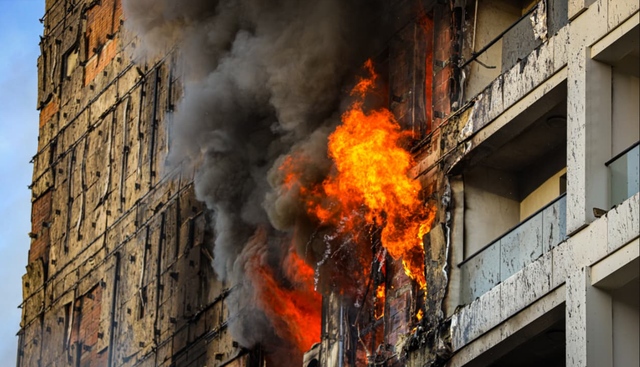
Fire at the 'Arlis' complex
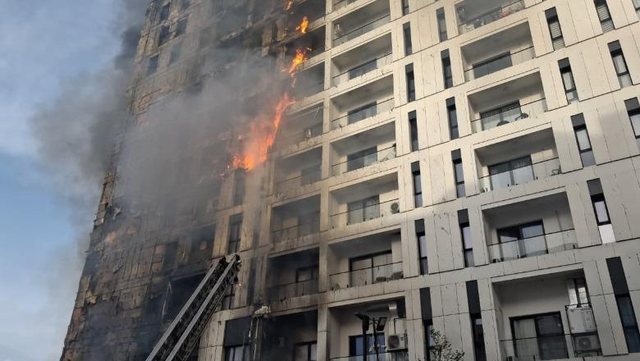
Fire at the 'Arlis' complex
But the case of the "Arlis" complex was not the only one.
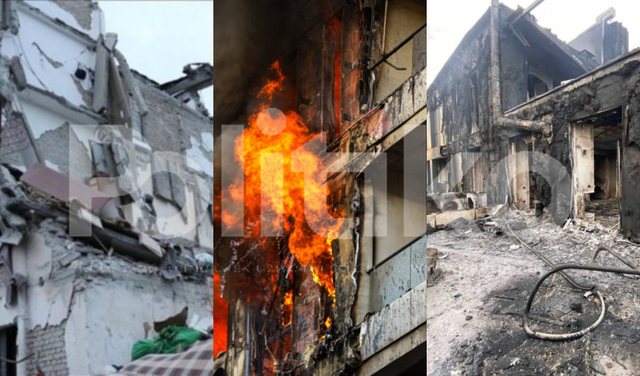
In September 2023, a fire on the terrace of a 10-story complex in the area of the former Bus Park engulfed the facade and the top floor of the building. Several apartments were severely damaged. The fire spread rapidly, favored by the wind and the polystyrene materials (hood) used in the facade of the building.
Rama has no answer for construction standards
In reaction to the event, Prime Minister Rama declared that the palace will be rebuilt 100% by the builder himself, linking the responsibility mainly to the security mechanism and not to the construction itself.
"The palace that burned down yesterday in Tirana will be rebuilt 100% by the builder himself, despite the fact that according to preliminary data the cause of the fire has nothing to do with the construction itself! Because we cannot leave the damaged people alone in their property and on the other hand, taxpayers cannot pay for a damage that should have been paid by insurance - a meaningful case for everyone to understand that home insurance against disasters is necessary", declared Rama.
However, this approach raises questions about the essence of liability in construction, as the focus shifts from construction standards and technical control to financial coverage of damage after the event.
Promises contrasted with legal actions
Edi Rama warned of 7–15 years in prison for builders who violate the law and a full investigation into every damaged building. However, many cases continue to drag on in the courts or have not yet produced clear public accountability.
Naturally, in this context, several questions arise: Have new constructions really been inspected? Who is responsible when a new building burns down or is damaged? Is the inspection system working? And are we dealing with a lack of technical control and supervision?
The construction workers who killed 51 people on November 26 were not brought to justice. After the earthquake of November 26, 2019, about 17 arrest warrants were issued. Of these, 9 people were arrested, while 8 others were declared wanted.
The security measures were mainly for construction engineers, supervisors/inspectors, local officials (municipalities, legalization, building permits) and people connected to the building certification process. So, more technical and administrative responsibilities, and not a “wave of imprisonment” of builders as articulated in political statements. Some of them were later released with milder measures or the processes remained dragged out in the courts.
The fire in the 10-story complex at the former Bus Park in 2023 did not result in any arrests of the builders or those responsible for the project. The event was classified as accidental, while the investigation focused on technical causes, with no apparent criminal consequences. The building administrator and the owner of the apartment where the fire started were taken to the police and later released.
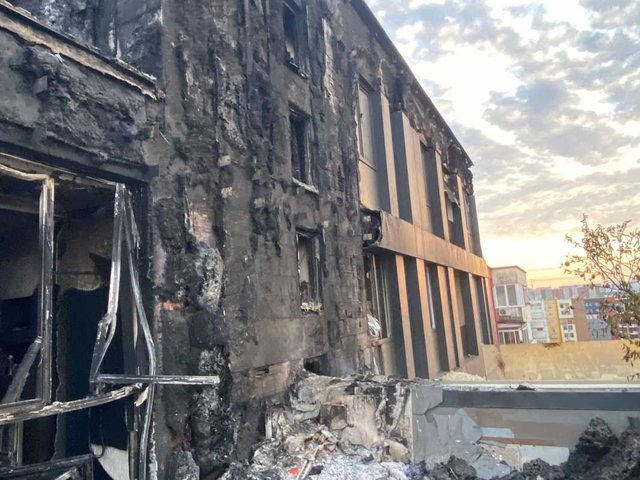
Apartment burned by fire in the 10-story complex in the area of the former Bus Park, September 14, 2023
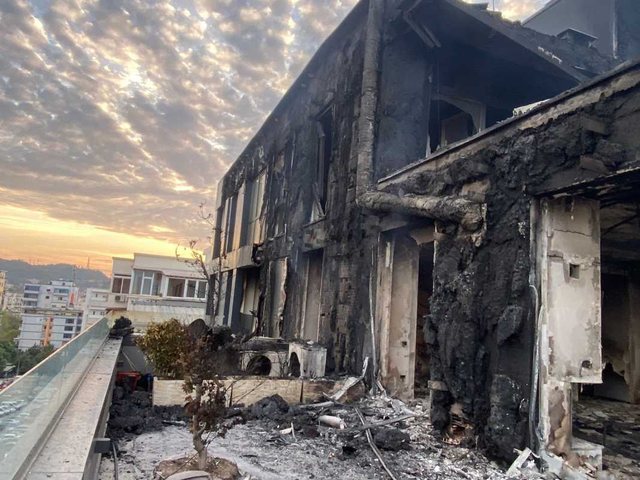
Apartment burned by fire in the 10-story complex in the area of the former Bus Park, September 14, 2023
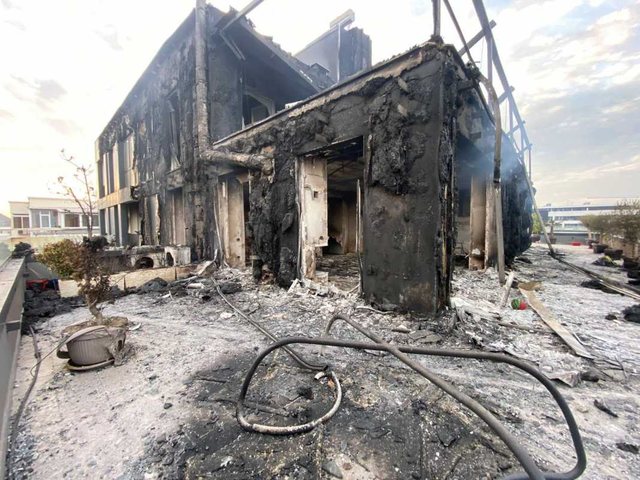
Apartment burned by fire in the 10-story complex in the area of the former Bus Park, September 14, 2023
Polystyrene as a construction 'molotov'
Polystyrene is a lightweight, porous plastic material that is produced in the form of plates (insulation panels). There are two main types: EPS (Expanded Polystyrene), the most commonly used in facades, and XPS (Extruded Polystyrene), which is more resistant to moisture and pressure.
The cap is the standard facade insulation system. The polystyrene boards are glued to the wall with special construction adhesive and then mechanically fixed. Dowels (plastic/metal nails) are added to keep it stable, as well as a protective layer where fiberglass mesh and protective plastering are placed. Finally, it is finished with decorative paint or exterior plaster.
When this system is combined with ventilated facades (air space), poorly protected polystyrene or polyurethane, and when fire barriers are missing, a critical risk is created. The air space functions as a “vertical chimney”, the insulating material can be flammable and in the event of a fire the flame spreads very quickly from the bottom up.
Under these conditions, what in theory is an energy-saving system, in practice can become a serious risk to the lives of residents.
Latest news

Here are the years of imprisonment requested for Monika's mother
2026-07-13 14:09:46
EU appoints German diplomat as new special envoy for Kosovo
2026-07-13 13:55:29

Property alienation in Durrës/ Court confirms security measures for suspects
2026-07-13 13:25:00
70 people with poisoning symptoms in Pristina, 22 hospitalized
2026-07-13 13:16:00


Erkin Lika's lifeless body found after falling into Mat River sinkhole
2026-07-13 12:32:00
Over 500 babies named after Haaland after World Cup matches
2026-07-13 12:28:00
18 arrested in Spain, who is the Albanian known as 'Daci'?
2026-07-13 12:22:00

4.2 million euros for Kanye West, DP reports Rama and Gonxha to SPAK
2026-07-13 11:27:03

Heatwave hits Germany, over 5,400 heat-related deaths
2026-07-10 10:45:33

Land in "foreign hands"
2026-07-10 10:26:15

Mbappe the hero of France, the "Roosters" knock out Morocco in the quarterfinals
2026-07-10 09:54:33
Durrës/ 40-year-old man stabs his wife
2026-07-10 09:48:03


How much could the amount of drug money in the Albanian economy be?!
2026-07-10 09:08:34
Government reduces funds for farmers, increases ADF by 75 million euros
2026-07-10 08:55:46
Horoscope, get to know the star forecast
2026-07-10 08:32:54

Morning Post/ In 2 lines: What mattered yesterday in Albania
2026-07-10 07:52:04
A person was shot dead in Kurbin, first details
2026-07-09 22:54:48

Will the Police also stop those who criticize Rama online?
2026-07-09 21:57:02


FIFA decision shocks England, Quansah ruled out for two matches
2026-07-09 20:51:00
Protest/Pedagogue: 4 million euros for Kanye West is "the next concession"
2026-07-09 19:45:53
French MEP joins protests in Albania: Support for the "Pink Flamingo Revolution"
2026-07-09 19:28:07

Has the lek strengthened or overvalued?
2026-07-09 17:58:05


The trial on the merits for Ilir Meta and Monika Kryemadhi is postponed
2026-07-09 16:47:58

The match between England and Norway risks being postponed, this is the reason
2026-07-09 16:12:46
Murder in Shkodra/ Relatives: Peaceful family, no problems
2026-07-09 16:10:02
Kurti invites opposition leaders to a meeting to create new institutions
2026-07-09 15:43:05
This is the 62-year-old man who killed his wife in Shkodra
2026-07-09 15:01:43

Domestic crime/ Wife killed with shotgun, perpetrator and victim identified
2026-07-09 14:05:18
Gunfire in Shkodra, one victim suspected
2026-07-09 13:49:41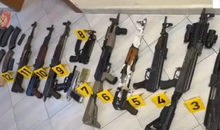
Weapons cache discovered in Fier, Prosecution sends 38-year-old to trial
2026-07-09 13:35:48

Bota e muzikës në zi, ndahet nga jeta në moshën 75-vjeçare ikona Bonnie Tyler
2026-07-09 12:56:29
Monika Kryemadhi in the Criminal Court: The cell phone was seized illegally
2026-07-09 12:45:54
VALEN MP reacts after border detention: Albania is no one's property
2026-07-09 12:15:44
Albanian gang in Belgium sentenced for trafficking 7 tons of cocaine
2026-07-09 12:01:14
Justin Bieber, Shakira and Madonna to perform at 2026 World Cup final
2026-07-09 11:52:54
Euro falls, inflation rises and domestic production loses ground
2026-07-09 11:39:36
Trial at the GJKKO, Meta's new lawyer appears in the session
2026-07-09 11:29:47
Nighttime accident in Gramsh, man and woman injured
2026-07-09 11:20:25
Meta seeks 134 witnesses, GJKKO delivers decision today
2026-07-09 10:56:54


At the peak of the production season, vegetable prices 'fly'
2026-07-09 10:21:14
The African heat returns, the thermometer reaches 40 degrees this weekend
2026-07-09 10:08:08
Opinions from 'anonymous' authors target Flamingo protests
2026-07-09 10:07:15
MEP Waitz: The law on protected areas endangers Albania's path to the EU
2026-07-09 09:52:55
"Le Courrier des Balkans": Edi Rama and the megalomania of power
2026-07-09 09:40:26
The economics of concerts, the prime minister's imaginary 100 million euros
2026-07-09 09:28:19
Erdogan's strange gift to NATO leaders
2026-07-09 09:11:15


Foreign exchange, the rate at which foreign currencies are sold and bought
2026-07-09 08:30:41
“Uniteti i jashtëzakonshëm” i NATO-s dhe mesazhet kryesore nga samiti në Turqi
2026-07-09 08:11:17

Horoskopi, njihuni me parashikim e yjeve
2026-07-09 07:46:15
Alternime kthjellimesh e vranësirash, parashikimi i motit
2026-07-09 07:25:59
Posta e mëngjesit/ Me 2 rreshta: Çfarë pati rëndësi dje në Shqipëri
2026-07-09 07:02:12